
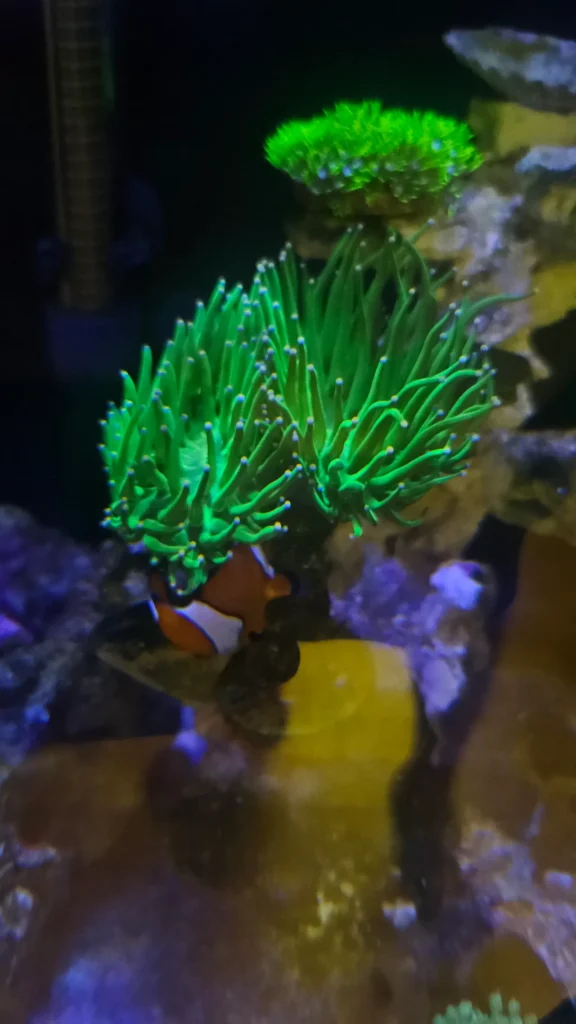
My once fluffy torch coral is starting to look bald.
Maybe the clownfish has been rubbing against it too much?
The clownfish I keep now, Jamo, really loves this torch coral.
The other captive-bred clownfish I had before did not care about corals at all.
When people talk about clownfish in reef tank communities or YouTube comments, I think most people picture them rubbing against an anemone. We did too.
But the captive-bred clownfish I had did not show any interest in corals.
So I had mostly given up on that idea. Then I saw the wild-caught clownfish rubbing against the torch coral for the first time, and I was honestly really happy.
Since the first time I noticed it, Jamo has been rubbing against the torch almost every time I look at the tank.
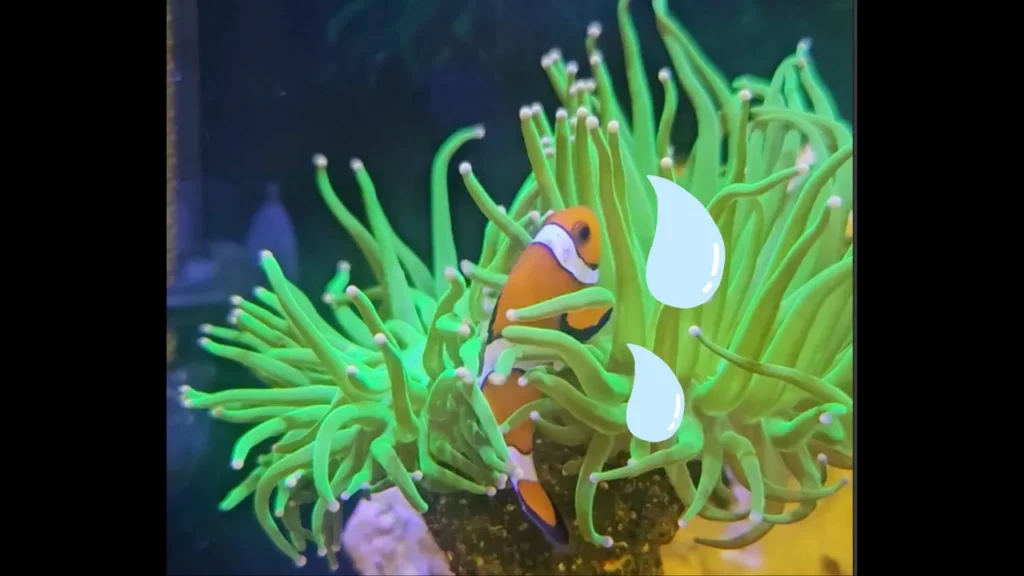
But about two weeks ago, the torch coral’s polyps started getting smaller like in the photo, and the mouth area became much easier to see.
I wondered if the temperature had gone up because it is summer, but it was 26 degrees Celsius, which is the same as usual.
Other corals like the acan, leather coral, and green star polyps are actually growing quickly, and they have looked even more active over the last two weeks.
I am also still doing a water change once a week.
The water parameters I checked today were:
- Kh/alk: 10.9
- Po4: 0
- No3: 0.25
Po4 is the phosphate reading. For corals, too much phosphate can lead to algae and water quality problems, but keeping it near zero for too long does not seem ideal either.
LPS corals like torch corals still seem to need a small amount of nutrients in the water to stay fully inflated. When Po4 reads zero, the tissue can look pulled in, and the mouth in the center can stand out more. So this time I am not only looking at Jamo rubbing against the coral. I also think the low Po4 may be related to why the torch coral’s mouth is showing. Of course, I cannot blame Po4 alone. The relatively high Kh, low No3, MicroBacter7, and limited feeding probably need to be looked at together.
After looking at those numbers and talking through the tank’s current condition with GPT, one suspicious point came up.
That was the MicroBacter7 I had been adding steadily, five drops every day.
Because this tank does not have a skimmer, I have been limiting feeding as much as possible and adding MicroBacter7 consistently.
I had been thinking of it as a bacterial supplement that helps break down organics, but that process may also help keep the tank’s Po4 level low.

I am going to use Brightwell NeoPhos to raise Po4 very slowly and watch how the torch coral responds.
If Po4 gets too high, I will probably have to fight algae again. Saltwater tanks really are not easy.
Update (2026-08-03)
The 26°C here was measured with a glass thermometer. I later found out it reads 2°C low, so the water was actually 28°C. I need to go back over the part where I ruled temperature out.
Wrote it up separately → The Glass Thermometer That Was Reading 2°C Low