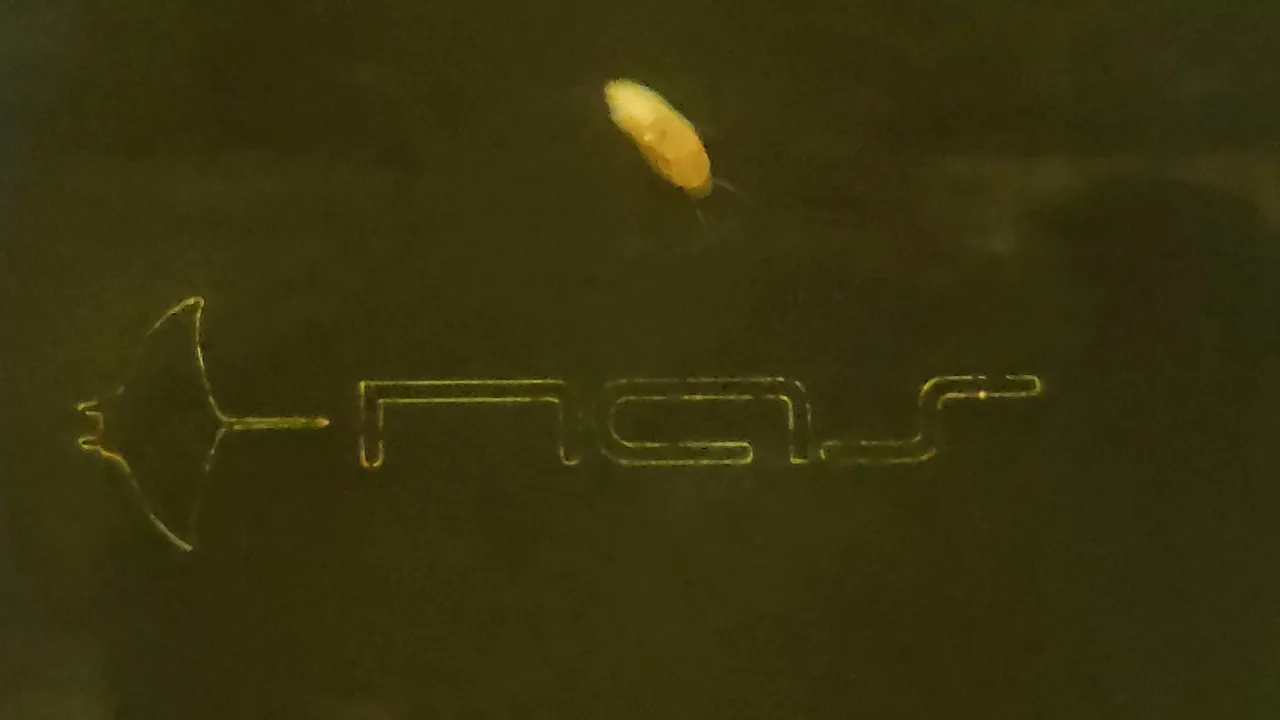
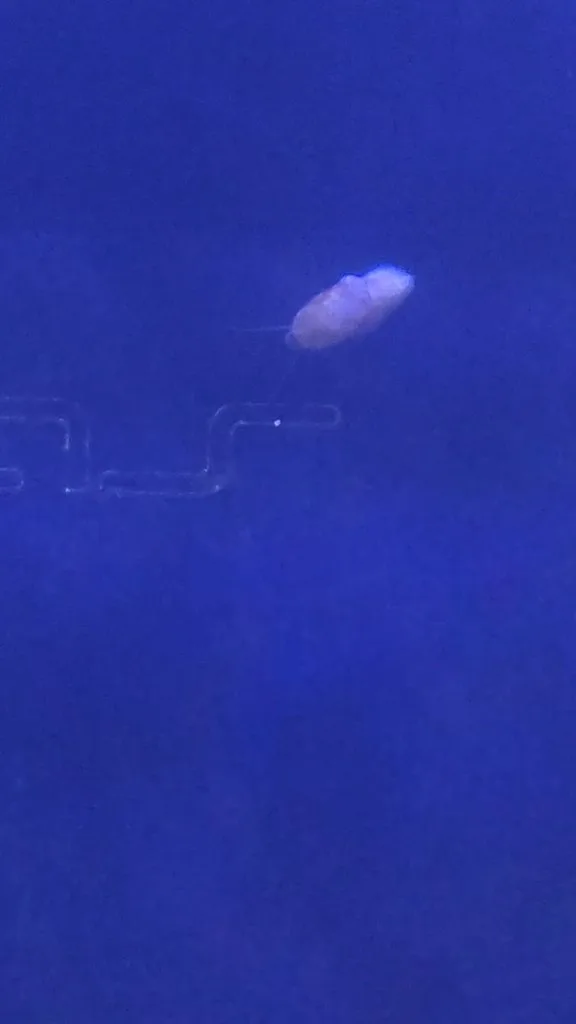
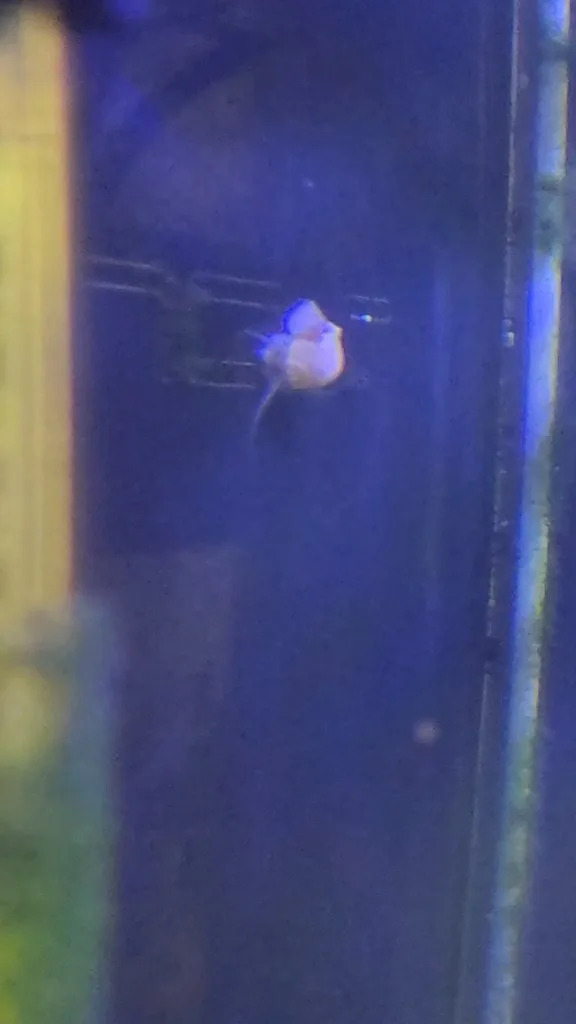
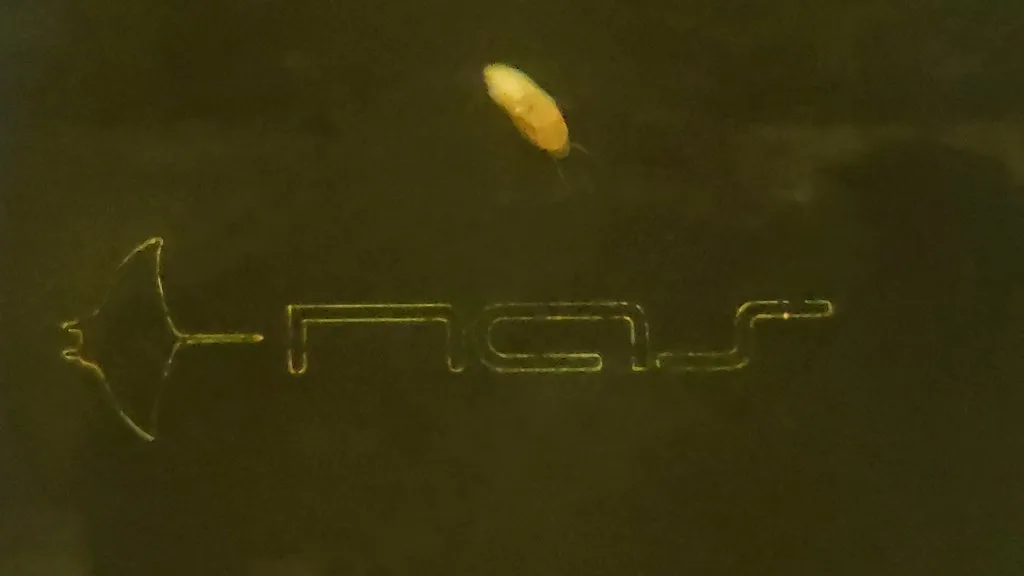
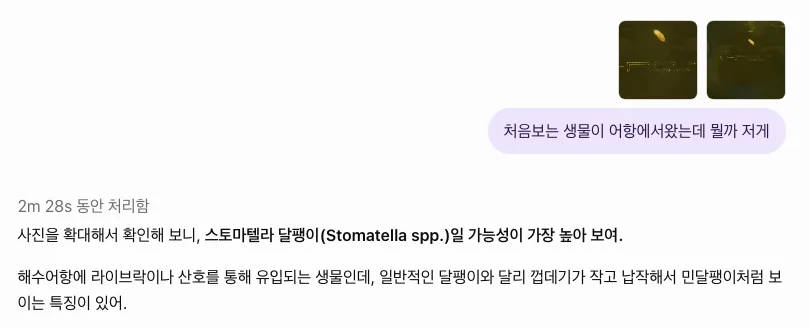
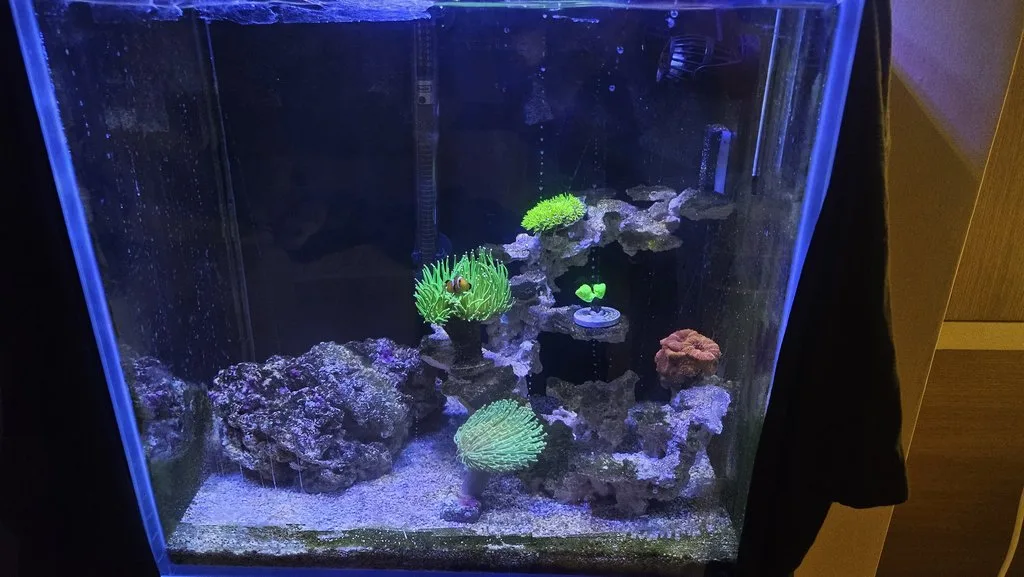
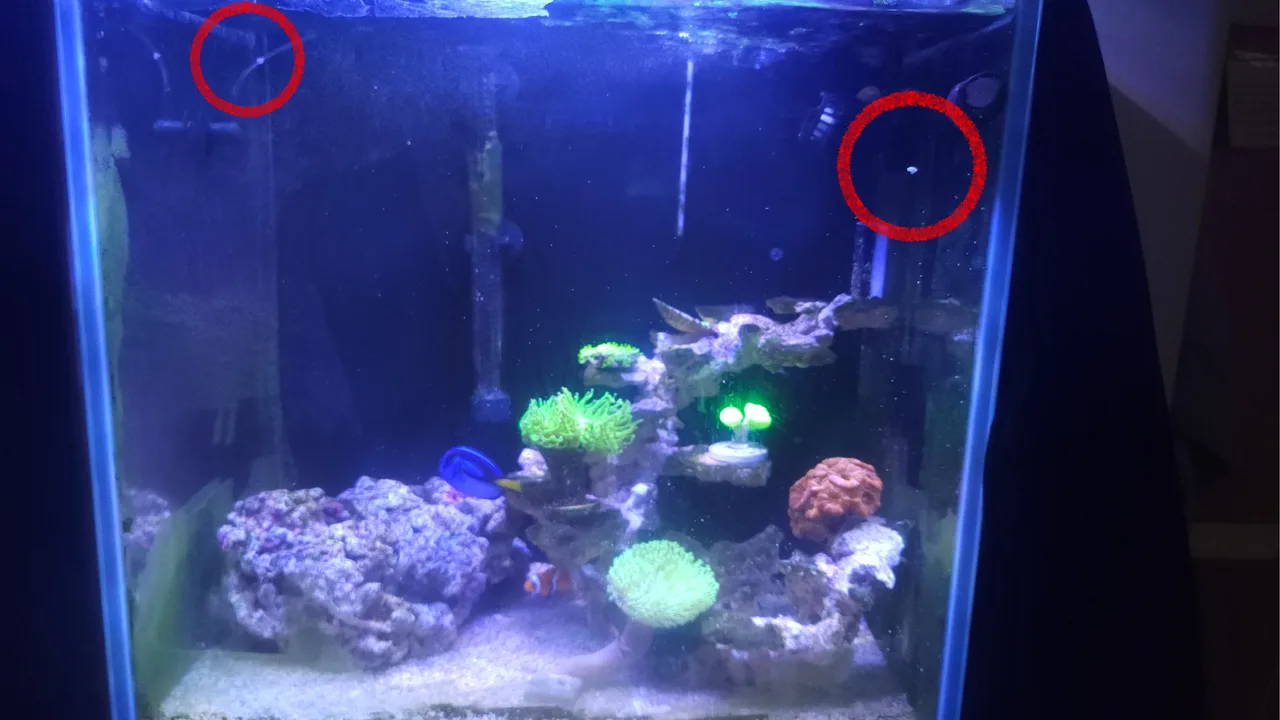
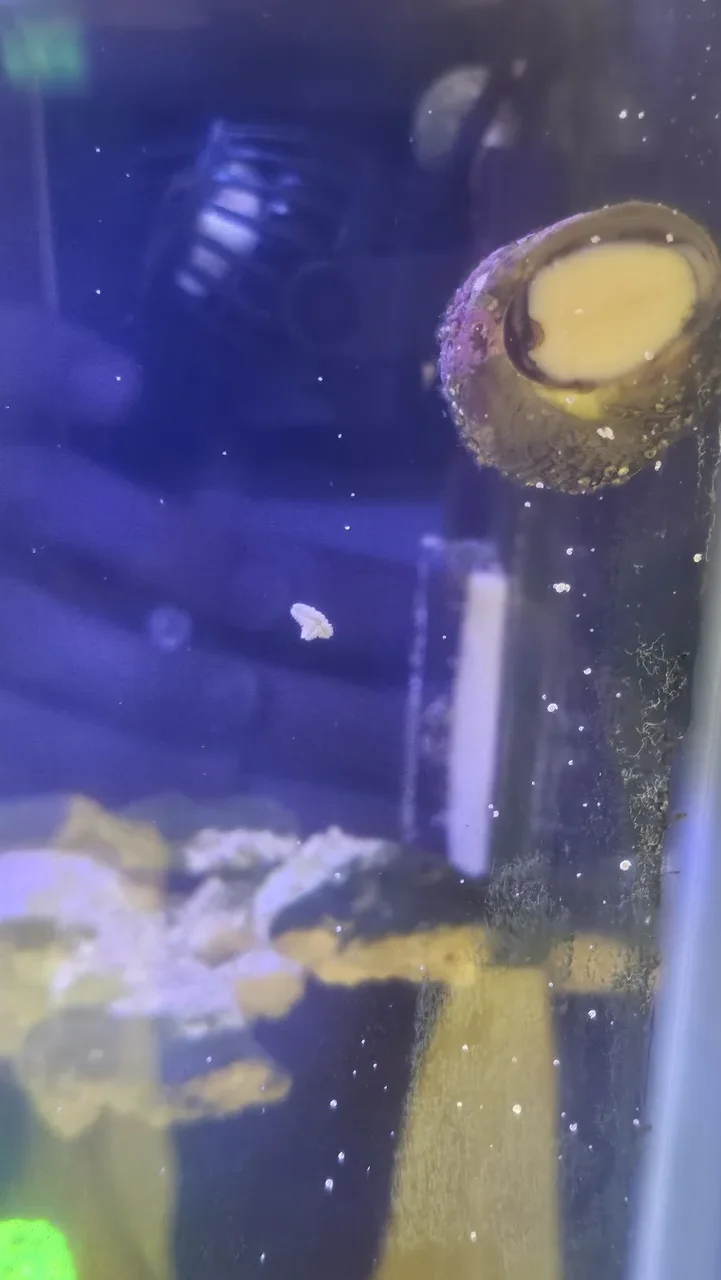
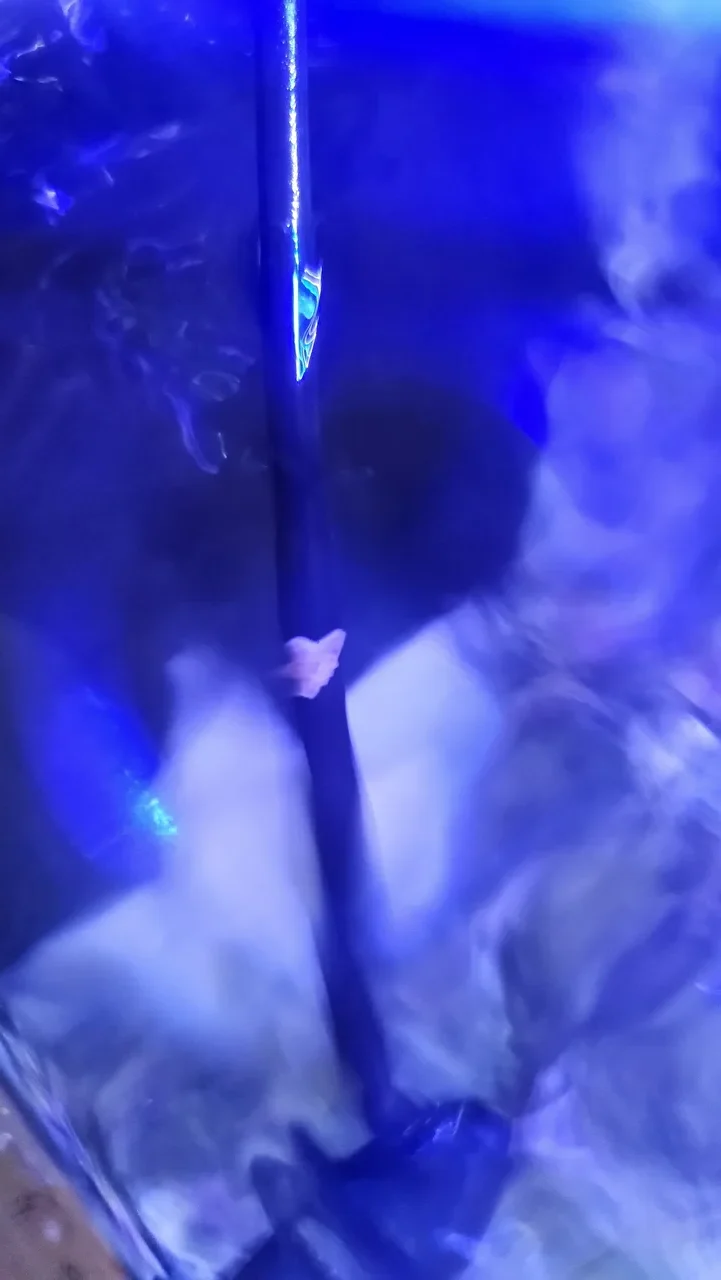
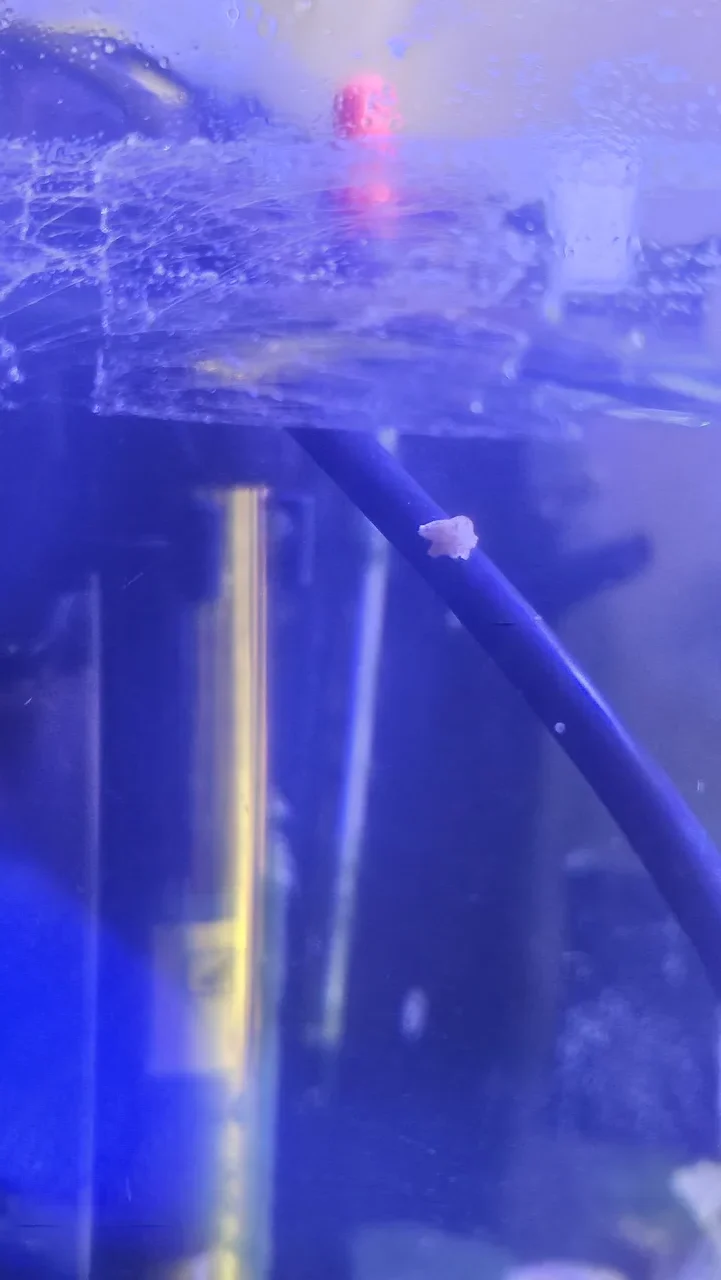
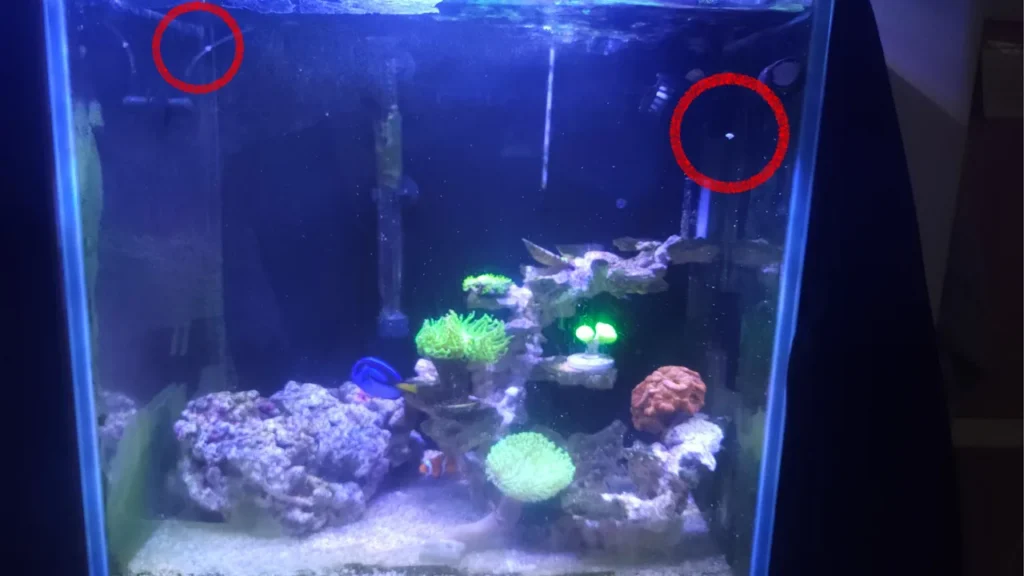
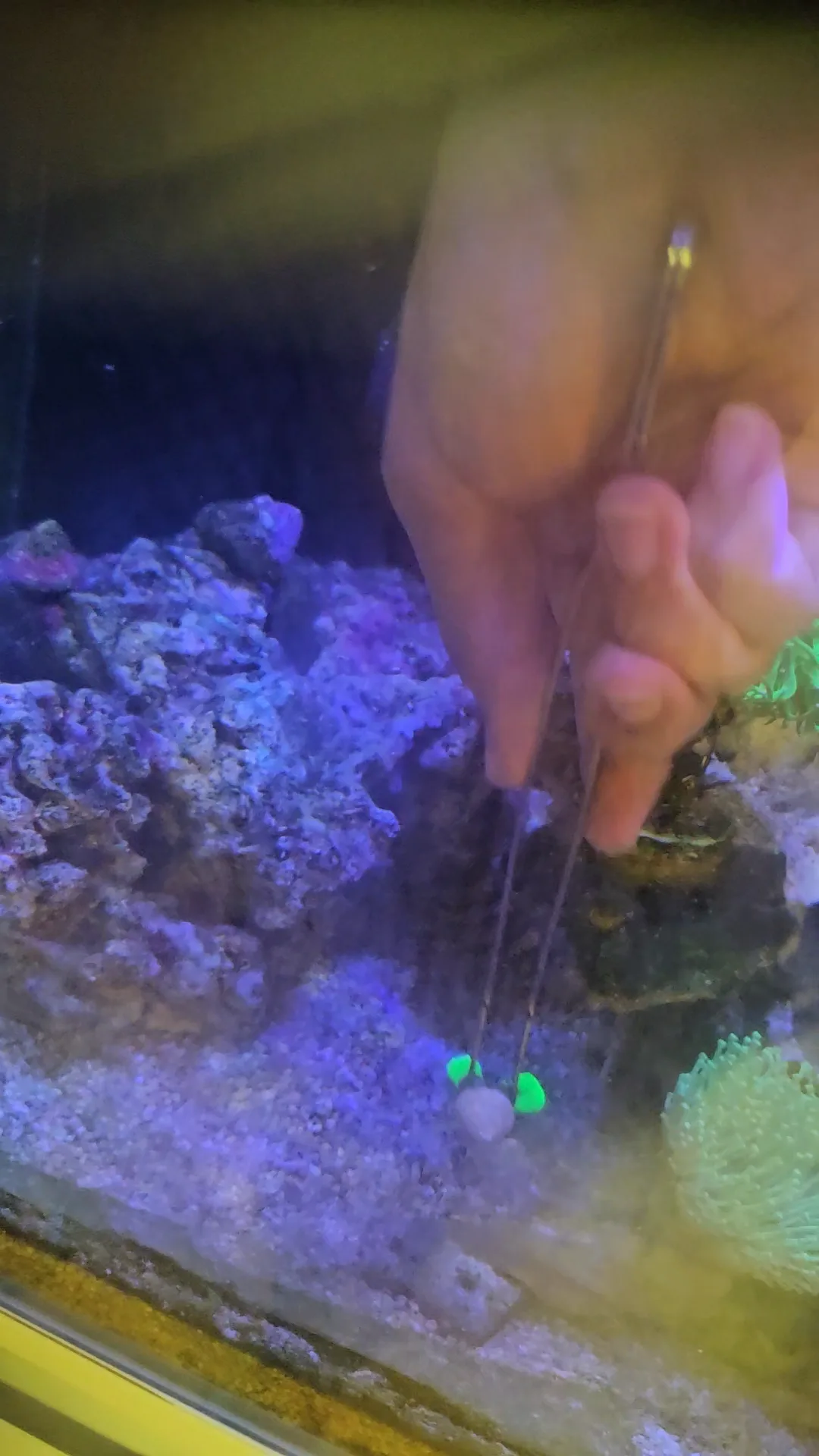
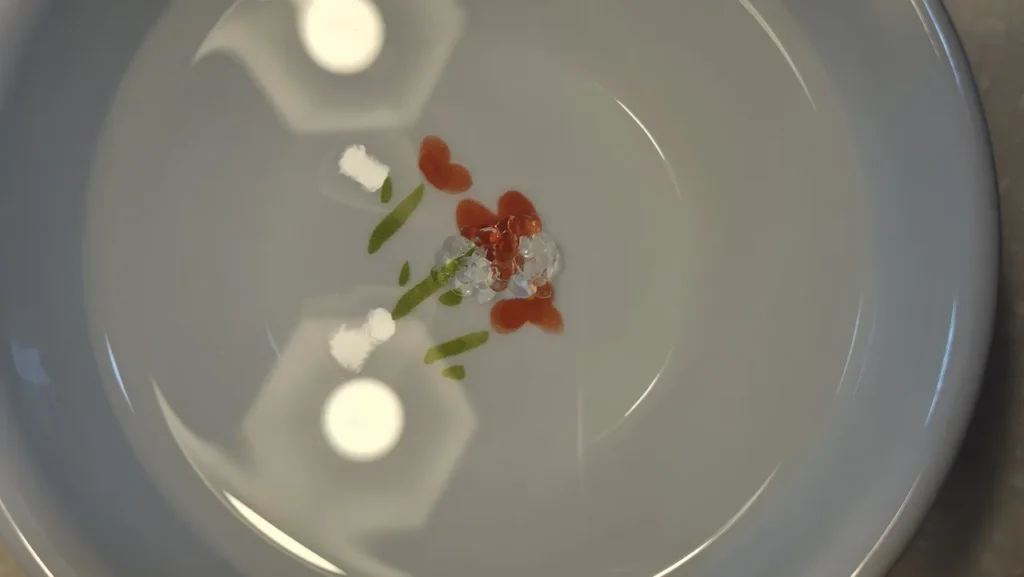
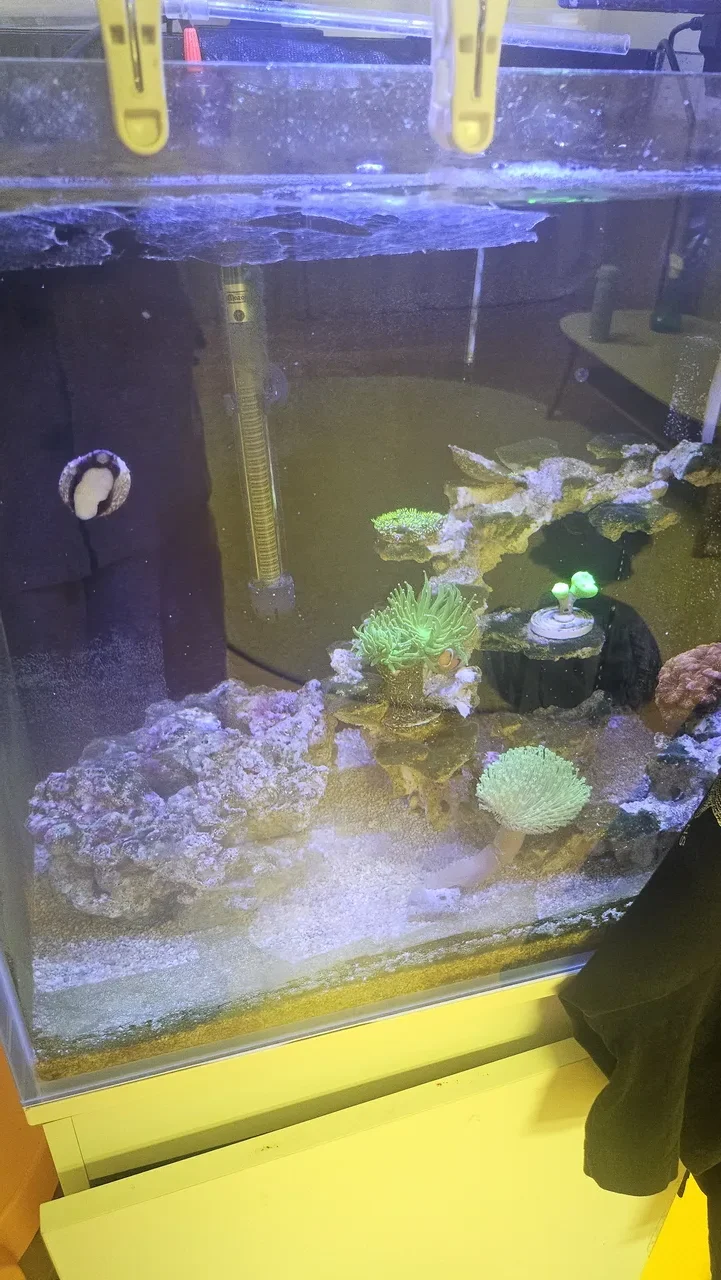
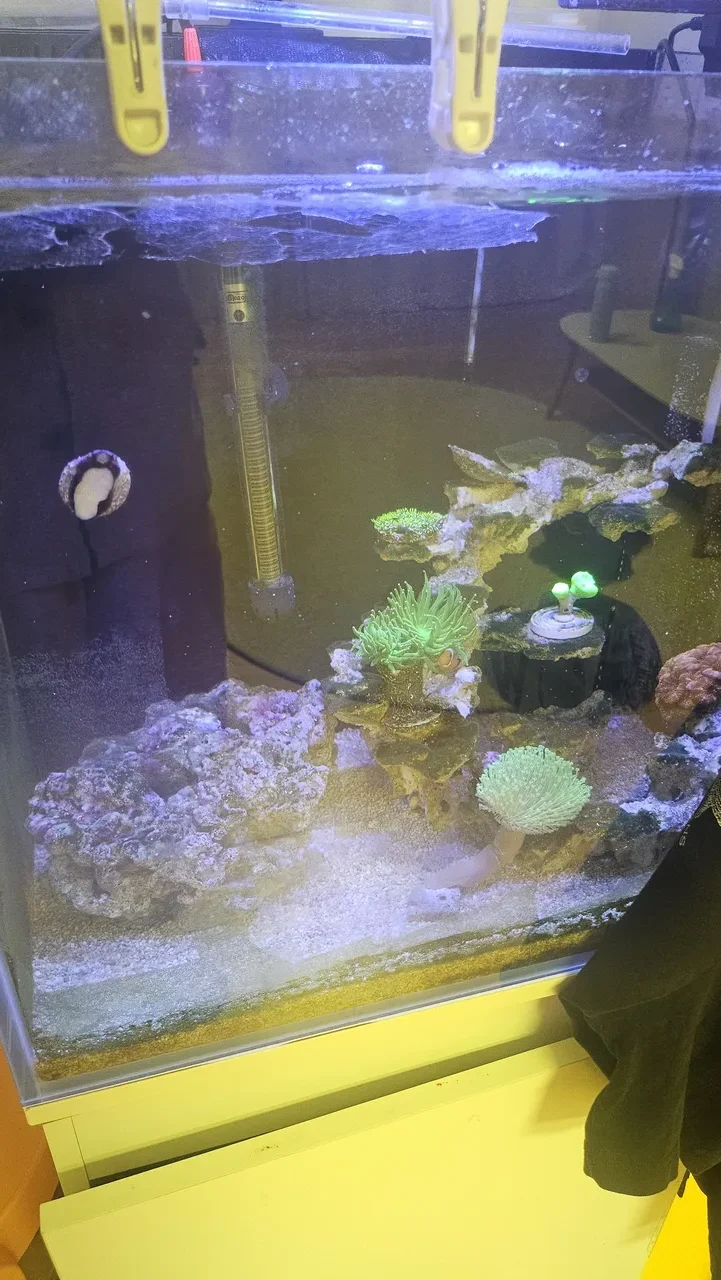
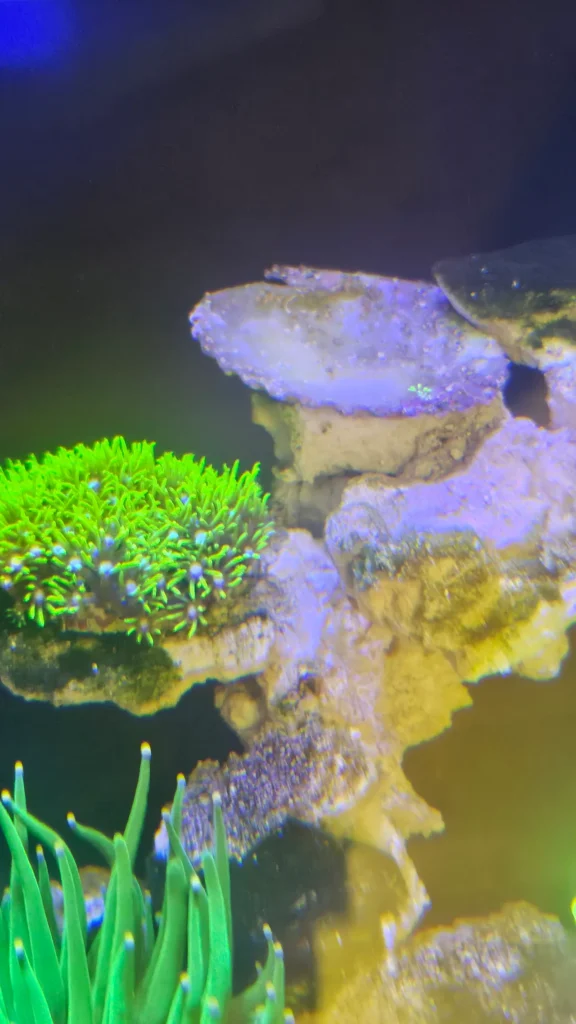
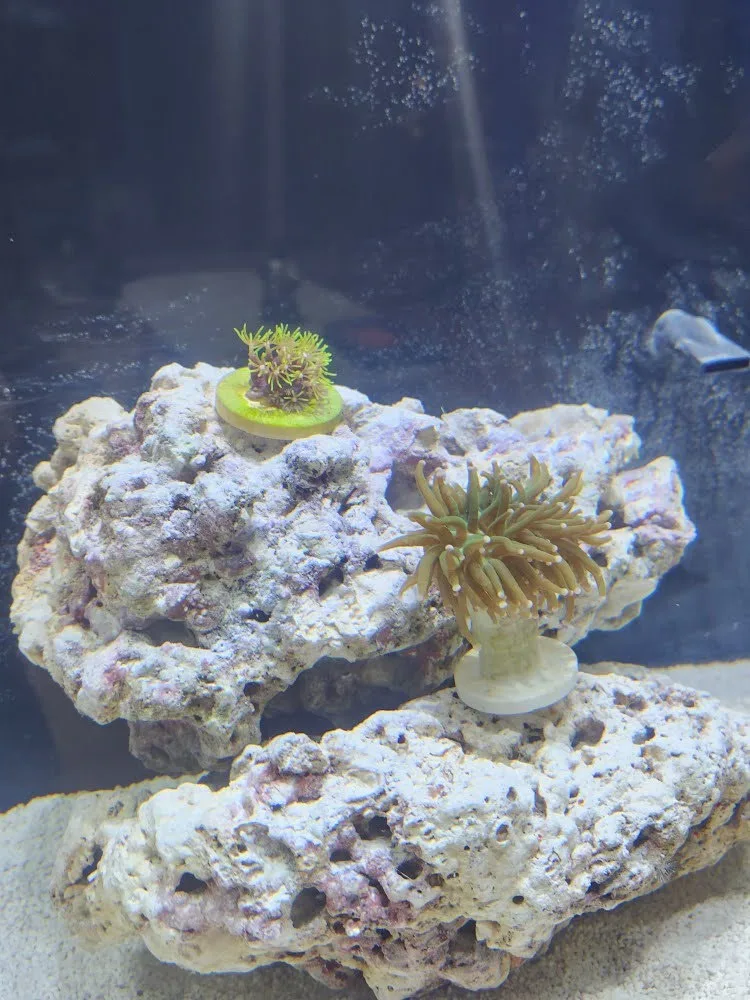
A new hitchhiker turned up while I was looking at the tank after a weekend water change!
As usual, I was just staring at the tank after the water change when I spotted something big moving near the top.
Whenever I change the water, I look for small bristle worms and brittle stars and remove them before they get too big. I'd already caught a few little ones that day.
This one looked like a worm. Had I missed one? I wasn't feeling too happy as I took a closer look, but thankfully, it wasn't a worm.
That was a relief, though I still wanted to know what it was. As soon as I spotted it, I took some photos and asked GPT, "Hey, what's this?!"
Good.
I Googled Stomatella and compared the photos. Convinced that was what I'd found, I looked back at the tank to enjoy watching it. In less than a minute, it had hidden somewhere. I couldn't find it at all.
After reading that it eats algae off the glass and live rock and leaves corals and fish alone, I wanted to watch the little guy without worrying for a bit.
It probably slipped between the rocks. It still amazes me that there could be creatures in that live rock I know nothing about.
I've come across all sorts of hitchhikers: crabs, bristle worms, Aiptasia anemones, brittle stars, sponges, and more.
I've tried hard to remove some of them and spent time looking things up. Whether I like finding them or not, these discoveries have become part of the fun.
I can't completely control everything living in the tank anyway. I've changed my approach a bit: relax, and just keep things from multiplying too much or getting too big.
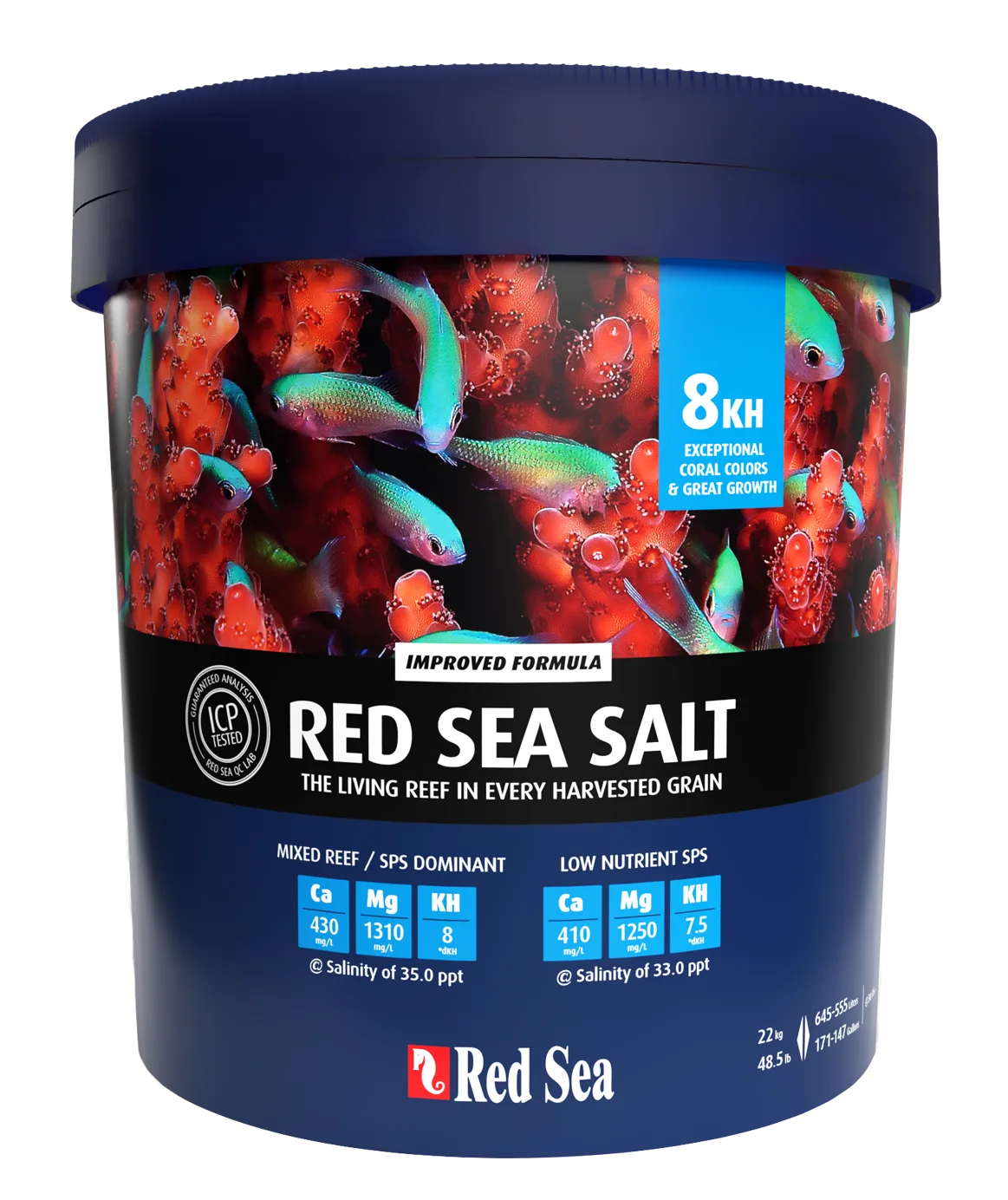
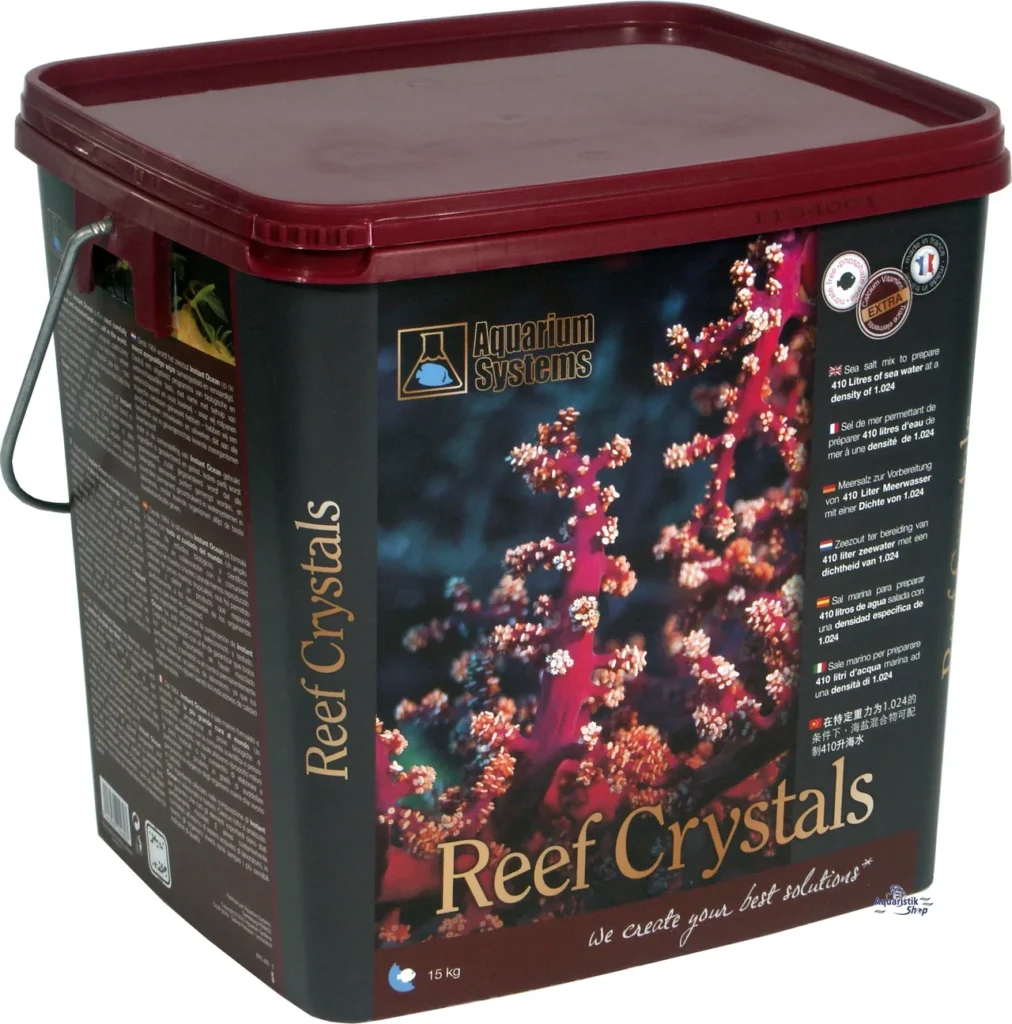
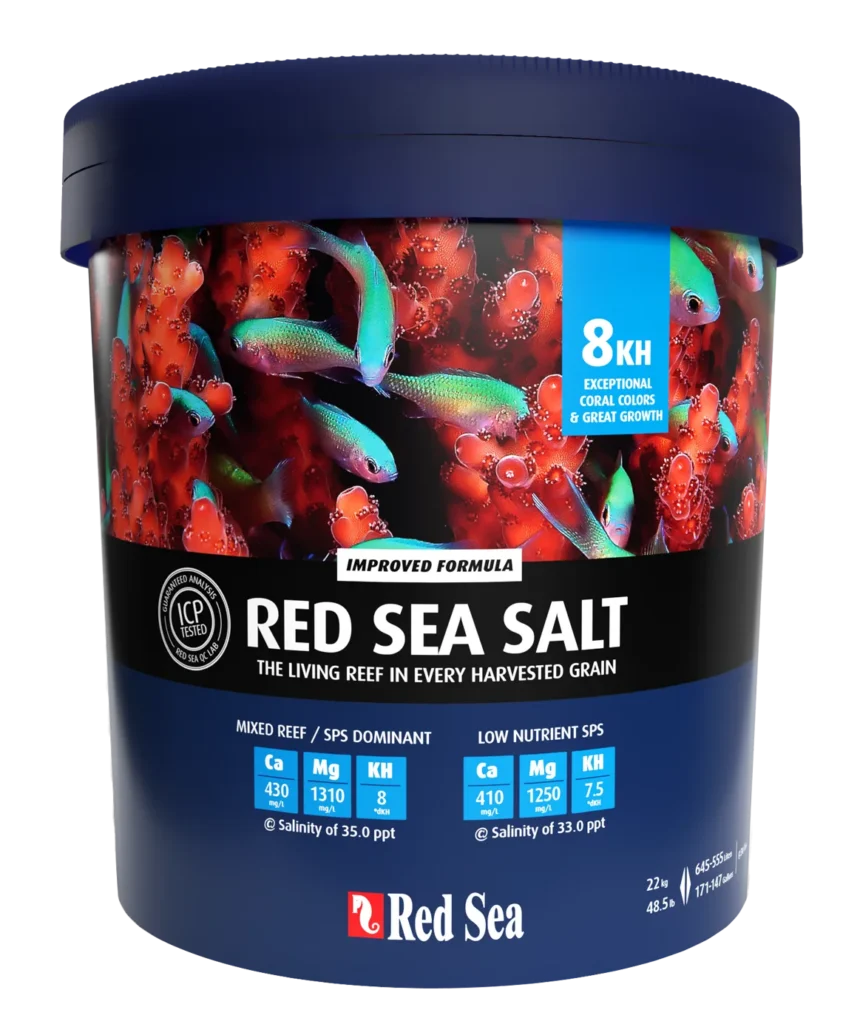
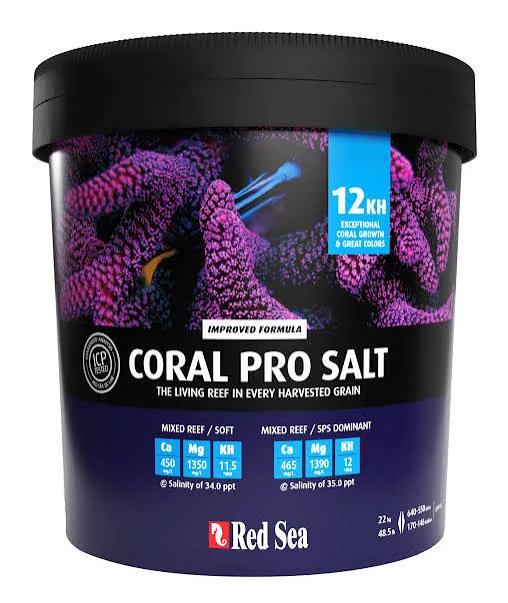
I had been using Reef Crystals, which is relatively nutrient rich. To keep my KH/Alk where I wanted it, I switched to Red Sea Salt rather than Red Sea Coral Pro Salt and was happy with it. Then I could no longer find a seller for the 7 kg bag.
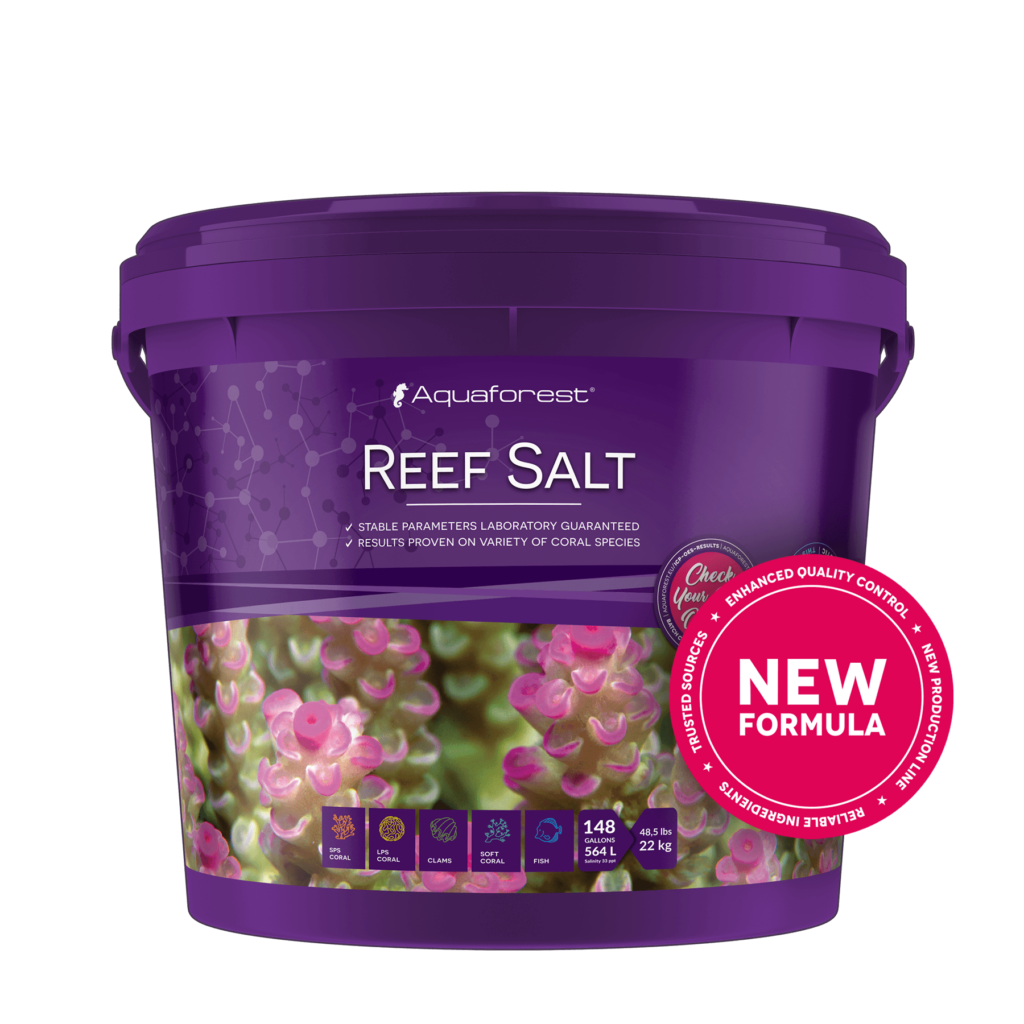
The 22 kg bag is more salt than I want to keep around, so I bought Aquaforest Reef Salt as an alternative and have now done two water changes with it.
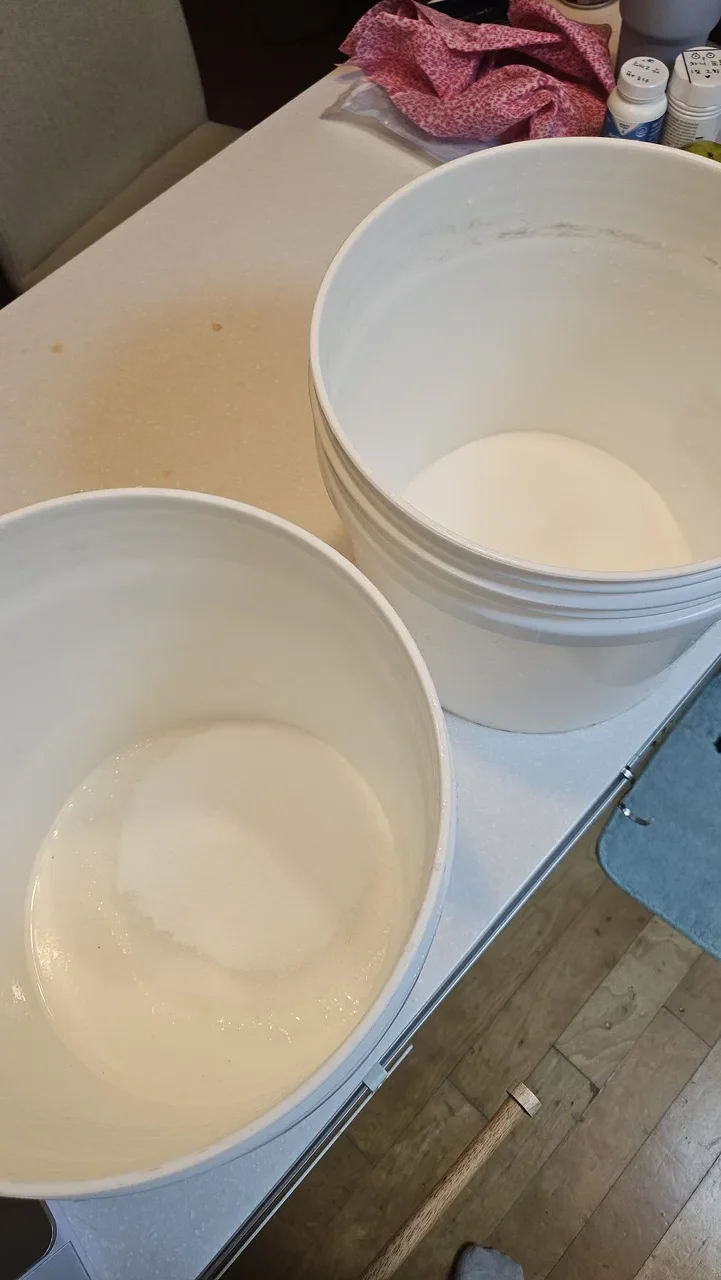
My 45 cm cube holds roughly 80 L. I change 20 L once a week, mixing 900 g of salt to aim for a specific gravity of about 1.025.
I did not record the first water change, so unfortunately I have no data from it.
I thought I had recorded it. When I realized I had not, I made sure to take better notes during this water change.
These were the parameters after my last water change with Red Sea Salt:
NO3: 5–10 ppm
PO4: 0 ppm
KH/Alk: 8.8 dKH
Ca: 410 ppm
Two weeks later, after two weekly water changes with Aquaforest Reef Salt, I measured:
NO3: 5–10 ppm
PO4: 0 ppm
KH/Alk: 9.6 dKH
Ca: 420 ppm
The other values were about the same. KH/Alk rose from 8.8 to 9.6 dKH, and I measured 10.9 dKH in the freshly mixed water before adding it to the tank.
I did not have time to test the other values in the freshly mixed water. If I were not writing this blog, I probably would not have measured even this much.
It came out lower than Reef Crystals and Red Sea Coral Pro Salt, but higher than regular Red Sea Salt.
I aim for 8–10 dKH, but I ran this tank above 13 dKH for more than a year and a half without problems that I could trace to that number. I have 6 kg left, so I will use it all before deciding anything.
In an earlier post, I compared the listed specs and expected a lower number than 10.9 dKH. Water-change volume, temperature, and other target conditions vary a little from tank to tank, so measuring it in my own tank was still the useful part.
A machine that made water-change water for me would be nice, though.
At least having a blog means even a water change can become something to post about. Maybe that is a good thing? Haha.
I have been running this 45 cm cube for about a year and nine months. For roughly the first year and seven months, I used Reef Crystals. For the last two months, I have been using Red Sea Salt.
I used to think a salt mix was mostly there to get the salinity right. I still think that is its main job. This summer, though, some of the corals in the tank were not looking their best, so I started checking the parameters with a Salifert test kit.
I now think the biggest part of that summer problem was water temperature getting too high. Before I fixed the temperature issue, though, I was also looking hard at an alkalinity reading of about 13 dKH.
The right KH range depends on the corals you keep and the kind of tank you want. For this tank, I felt that 8 to 9 dKH made more sense than 13. Since I had used the same salt from the start, I began to wonder how much the salt mix was helping hold that number up.
These are the Reef Crystals numbers. I kept the table in the specific gravity (SG) and temperature rows I use when mixing water instead of converting it into a ppt-only comparison.
I usually make water for a water change at a specific gravity of about 1.024 to 1.025. That made it easy to see why the fresh mix was above the KH range I wanted. I looked for a mix aimed closer to 8 to 9 dKH and landed on Red Sea Salt.
After two months with Red Sea Salt, I wrote down the test results below.
Date
KH/Alk
Ca
NO3
PO4
7/7
12.8
–
5–10
0–0.03
7/9
12.1
–
–
0–0.03
7/11
11.5
–
5–10
0–0.03
7/12
11.5
–
–
0
7/19
10.5
–
–
0
7/26
10.5
–
–
0
8/2
10.0
–
–
0
9/13 before water change
9.3
415
25
0
9/13 after water change
8.8
400
5–10
0
The alkalinity did come down. After using Red Sea Salt for about two months, it felt like the better fit for this tank, so I was ready to buy it again.
By then, I could no longer find the 7 kg size except for Red Sea Coral Pro, which is a different mix with higher targets.
I cancelled a few orders after ordering by size and realizing they were the Pro version.
While looking for an alternative, I ordered Aquaforest Reef Salt because its target range looked similar.
I had never seen a baby starfish. Until this happened, I had not given much thought to how starfish reproduce either.
One day, just before feeding my clownfish, I spotted a white speck on the front glass of my reef tank.
There are random white bits on the glass and in the sump that I still cannot identify. They sometimes look a little like scale, so I assumed this was one of those and left it alone.
I figured I would clean it off at the next water change. A few hours after feeding, though, it was gone.
A few days later, I saw a similar speck in nearly the same spot. I looked closer this time and realized it was a tiny starfish.
There is one sand-sifting starfish in the tank now, although I originally brought home two. One did not settle in, gradually got smaller, and died. The other has been living in the tank for several months.
Part of me assumed I would need a pair if there were ever going to be babies, so it never occurred to me that I might see one. When I did, I mostly just stared at it. It was tiny, strange, and very cute.
They are easy to miss and only show up when they happen to be out in the open. That makes it more fun when I do spot one.
Later, while taking pictures of one, I spotted a second.
One was on the front glass, and the other was near the temperature-controller sensor.
My wife and I stood there looking at them for a while. They barely move, but that somehow makes them even cuter in person.
Before this, the starfish mostly gave me small moments of entertainment by climbing the glass and occasionally falling off. I did not expect a much bigger surprise from it.
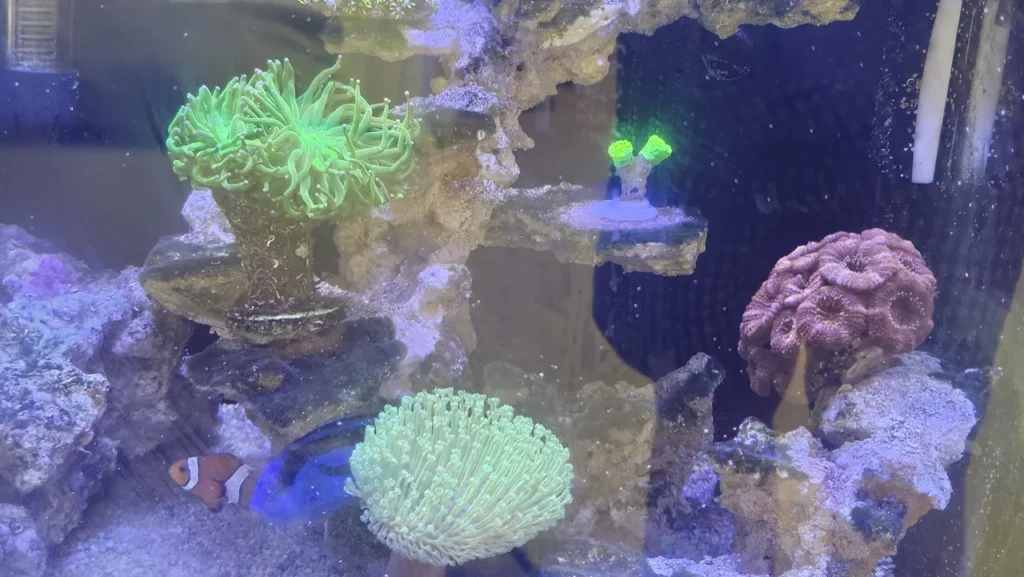
A 45 cm cube is a small tank, but unexpected things still turn up. I have had a crab come out from between the rocks, a huge worm appear, and an anemone suddenly show itself.
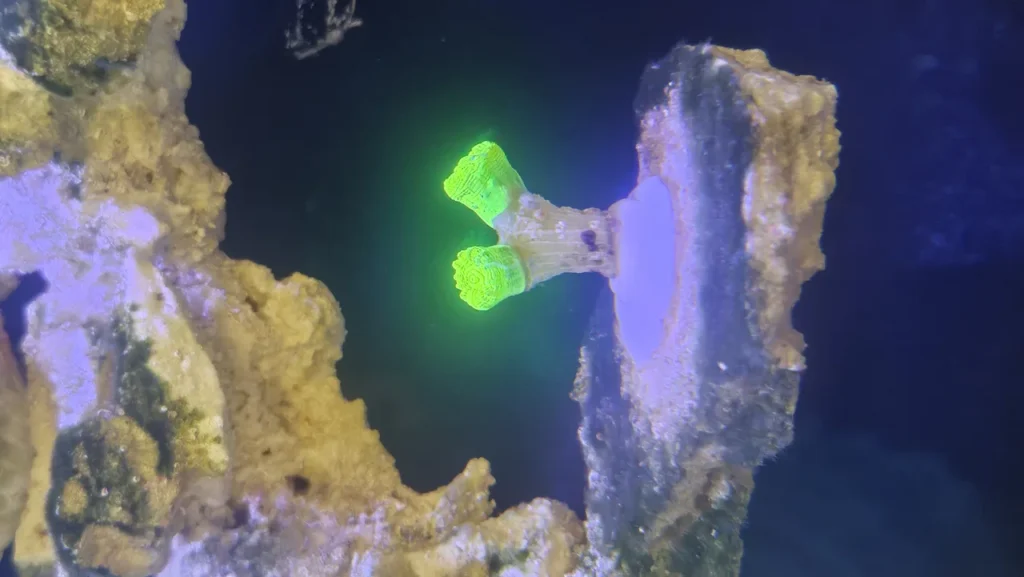
Like any other weekend, I had just finished a water change and was checking the parameters when my wife asked, “Where’s the candy cane coral?”
Sometimes I find the candy cane coral on the bottom of the tank after waking up or coming home from work. I assumed the snail had pushed it over again, so I said, “If it’s not where it was, isn’t it on the bottom?”
“No, its body came off.”
“What?”
I had never seen its body come off before…. What happened? The candy cane coral had been fine right up until the water change.
The candy cane coral was the last living thing added to the tank.
It has already been three months since I wrote that post. Unlike the other corals that had issues along the way—the leather and torch not extending their polyps, the acan losing color—it had never looked bad even once.
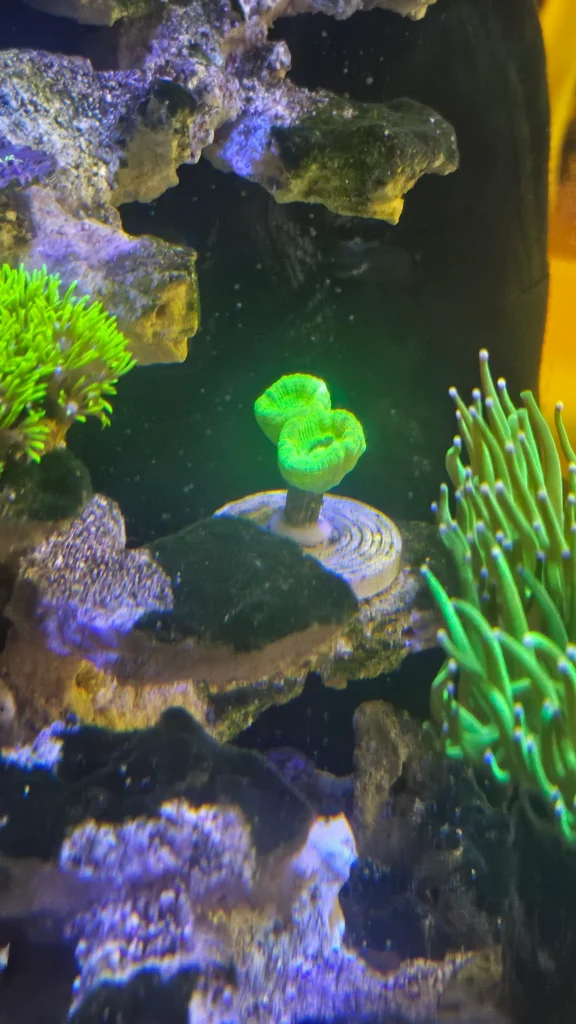
I keep thinking it looks exactly the same as when it first arrived, but when I look back at photos, it has grown little by little. It is fun noticing that, and despite looking still, it has been a dependable, reassuring coral.
A coral that had never caused a problem, and did not seem like it ever would, had come apart. I was completely taken aback.
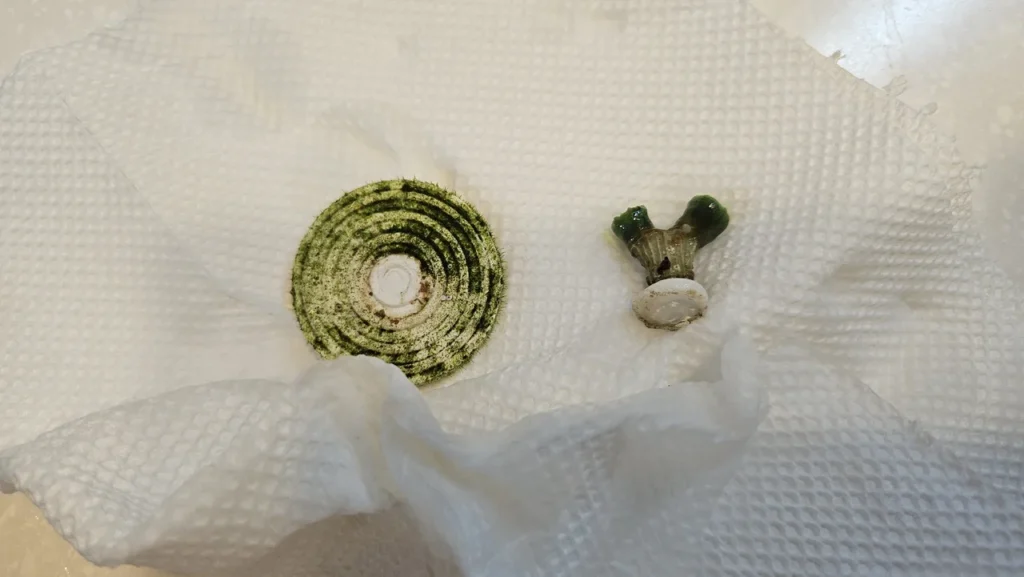
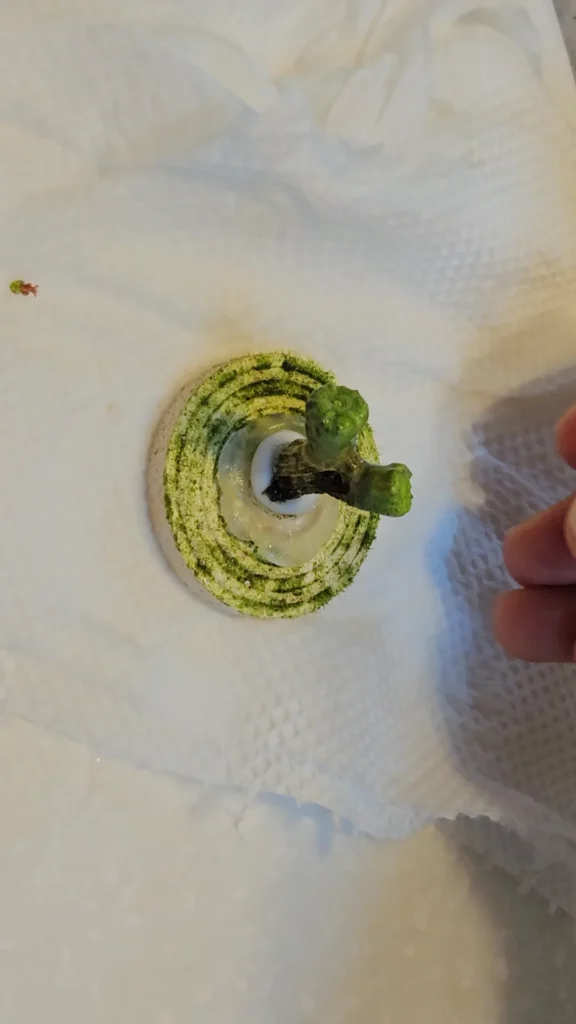
When I checked, the connection between the frag base and the candy cane coral had snapped.
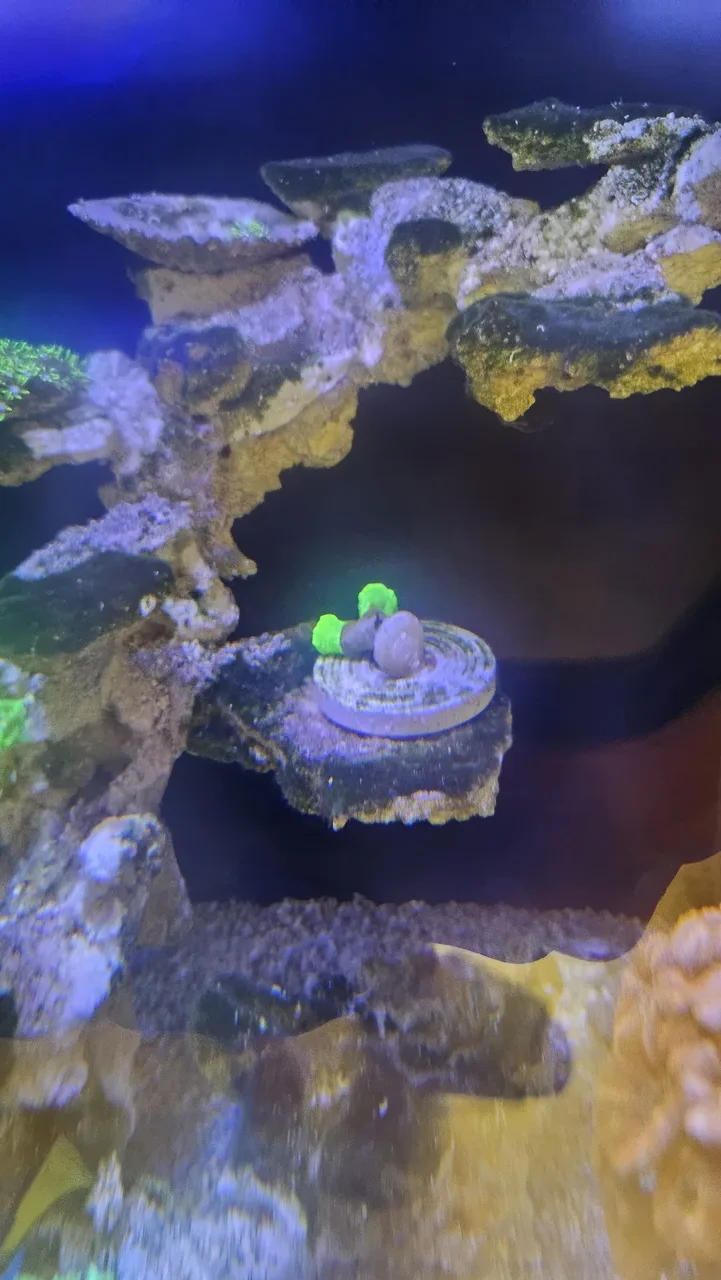
Luckily, the coral itself had not come apart. It looked like only the part that had been glued on had come loose, so I just needed to attach it again. Really, really lucky.
It should have been as simple as gluing it back on. But I remembered being told at the aquarium store that regular super glue could be bad for the candy cane coral and the other living things in the tank.
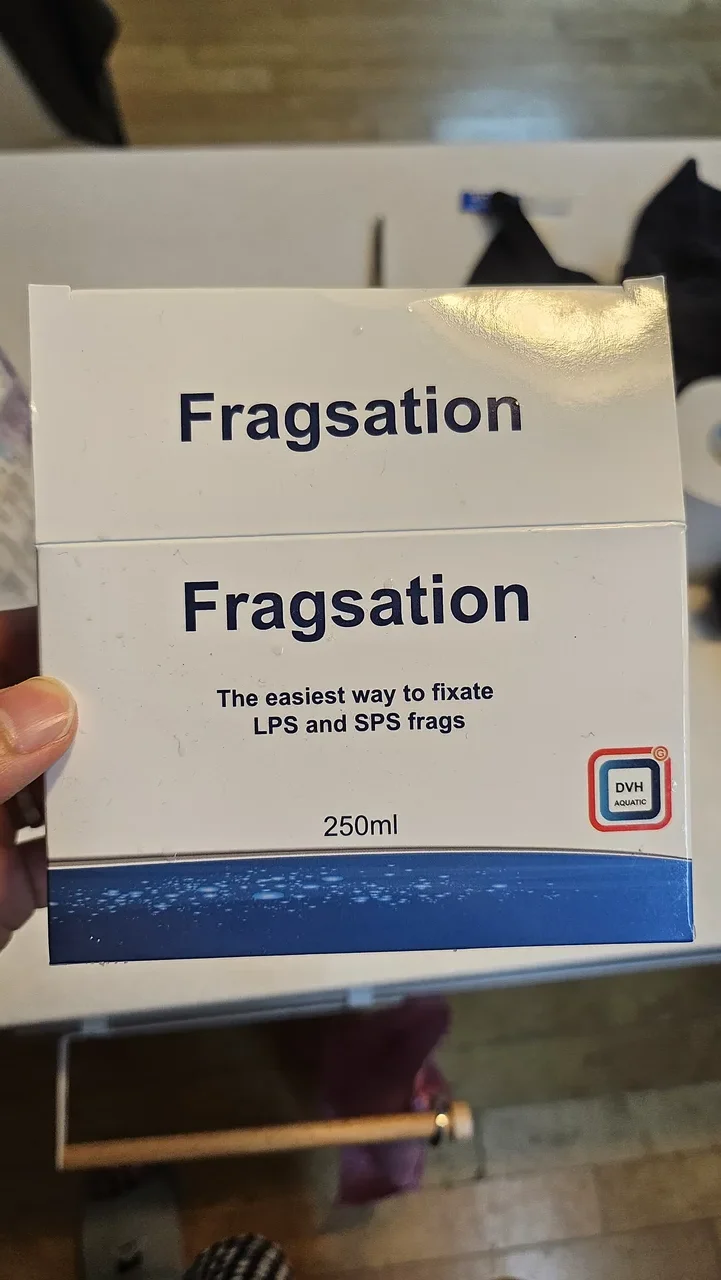
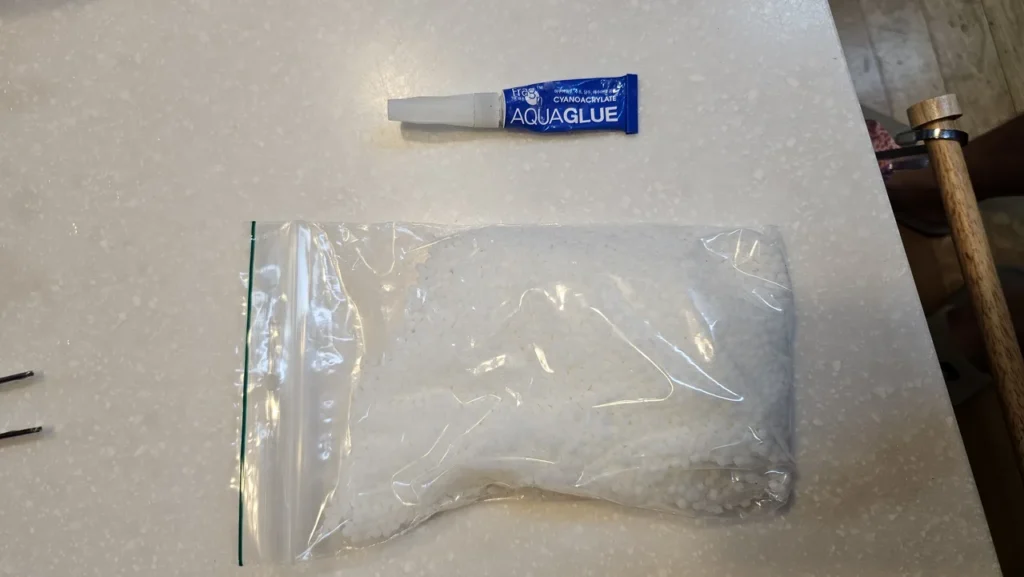
As I was wondering how to reattach it, I remembered the frag station and coral glue I had bought. I originally bought them because the frag base that came with the acan was so small and I wanted something to reinforce it with!
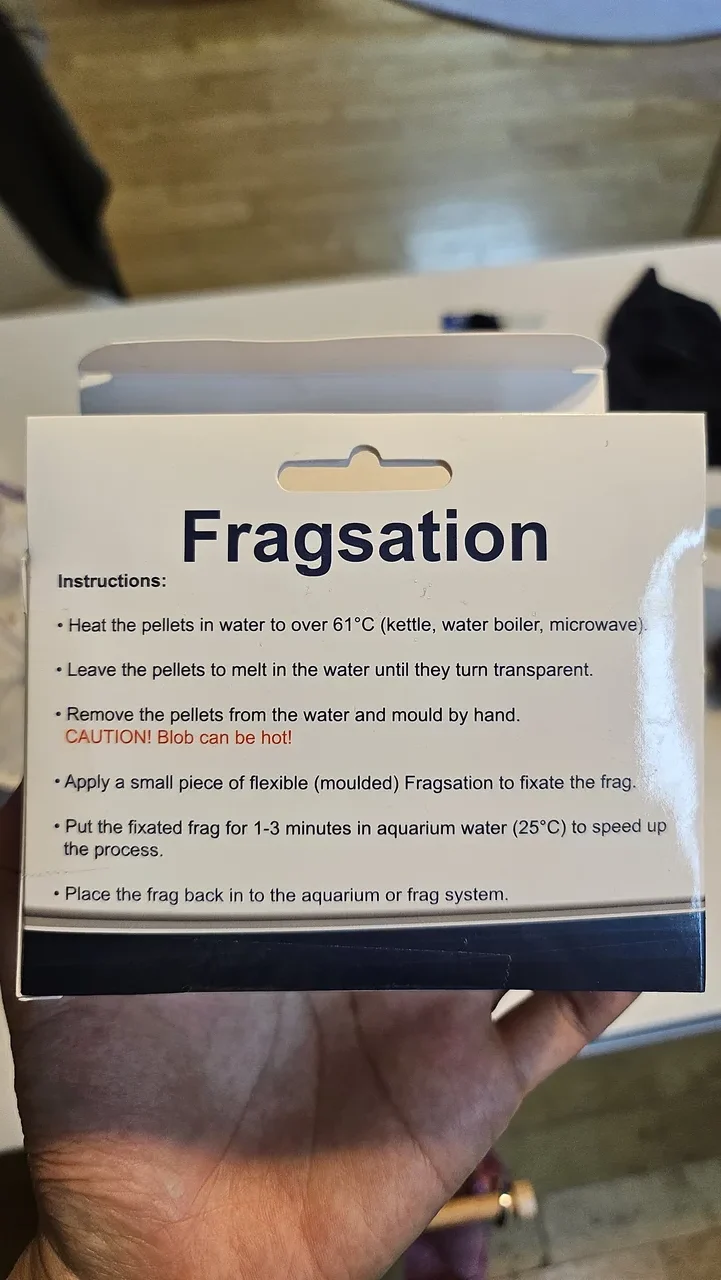
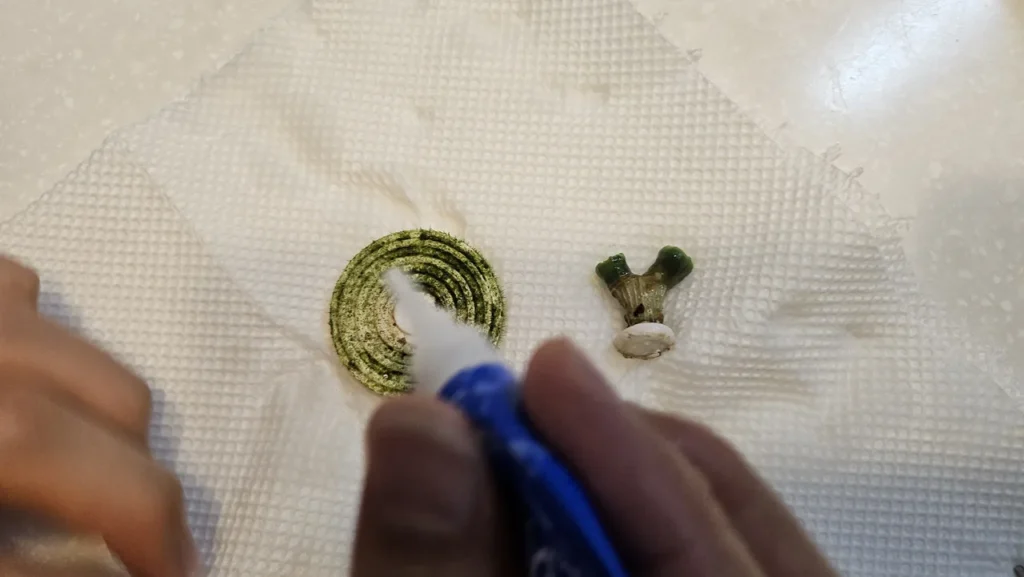
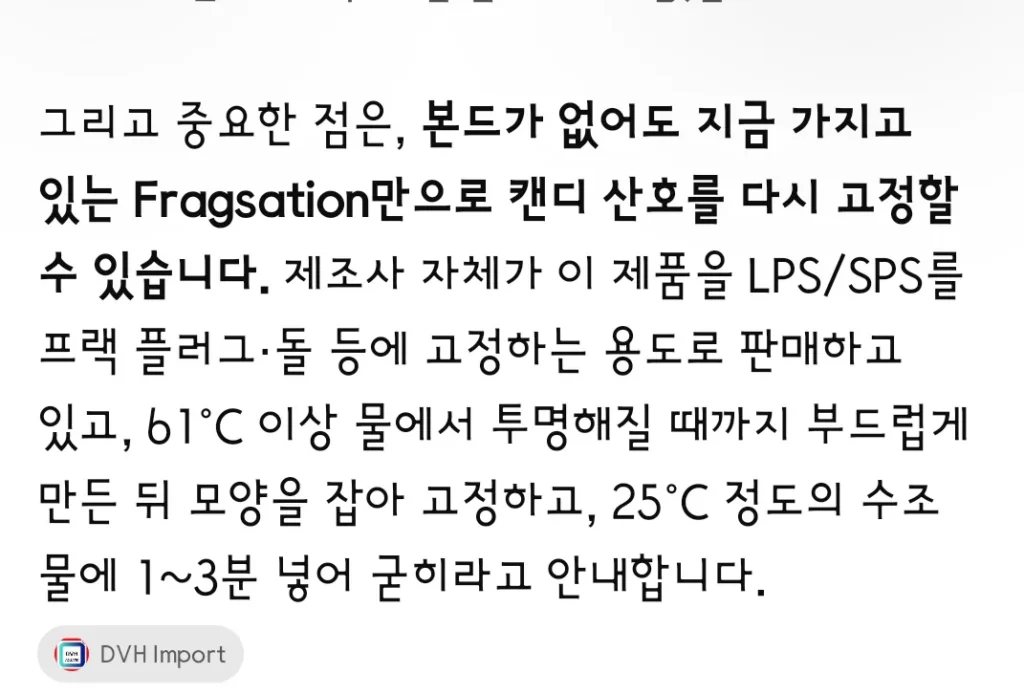
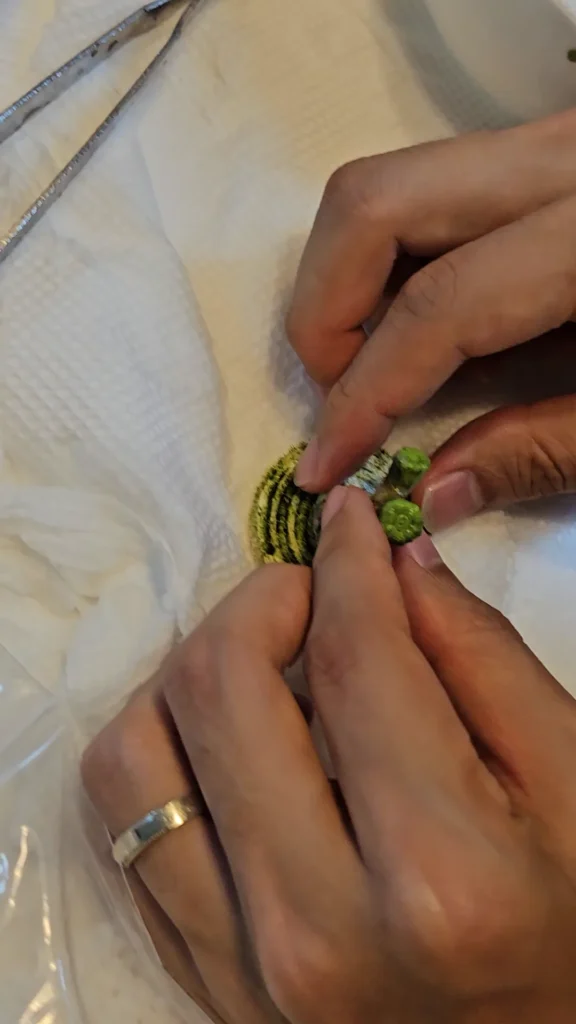
You soak those little white beads in hot water over 61°C. They soften up like clay, and once they are soft, you shape them, apply a small amount of coral glue, and attach them to whatever needs securing, like a frag base.
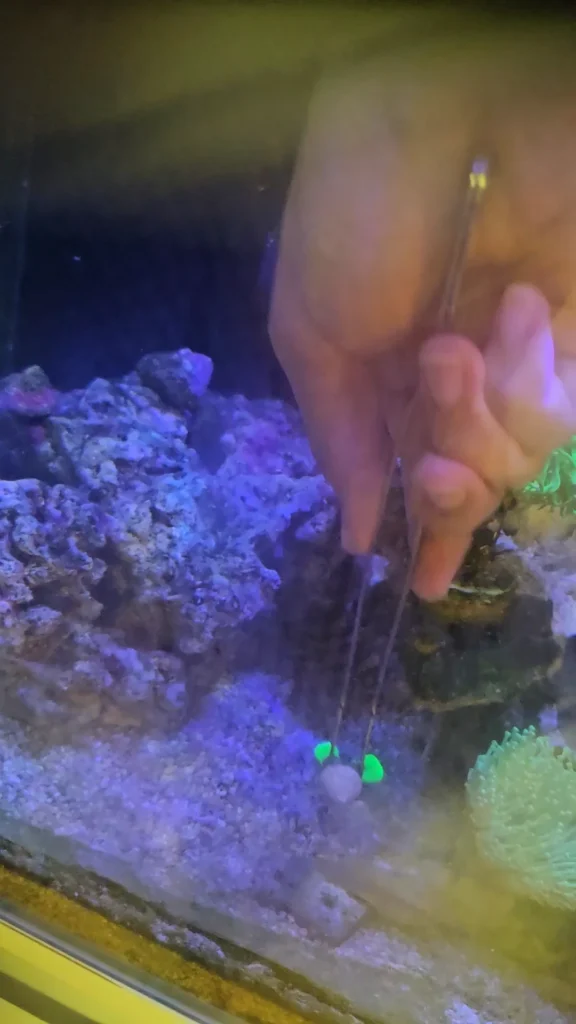
I was in such a rush getting it out that I dropped it and made a whole mess, but I got it out in one piece and prepared for surgery.
Whenever I take corals out of the tank, I think this: corals always look strange outside the lights… lol
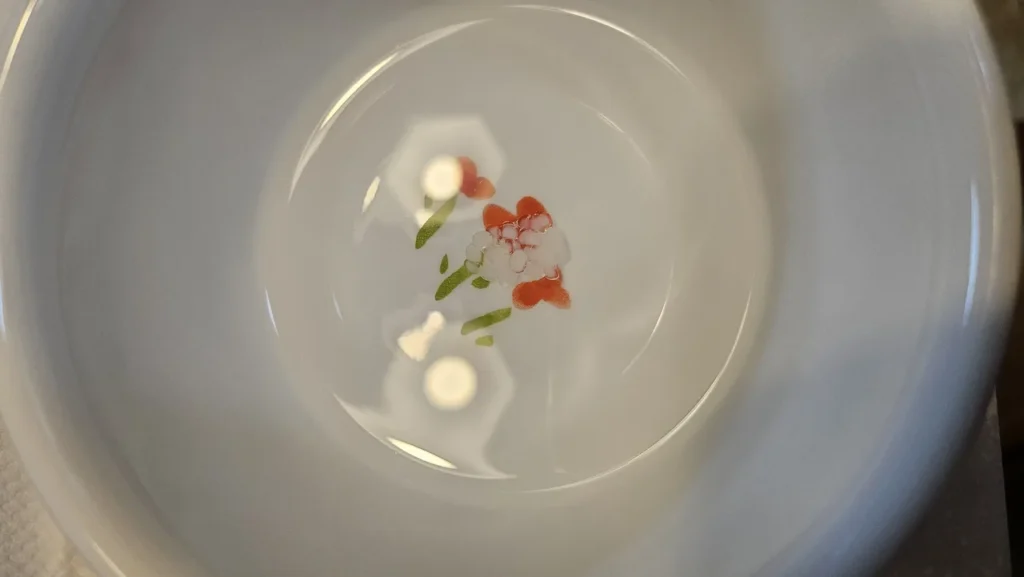
First, put a small amount of the white bead-like frag station material in a bowl and pour in hot water at about 80°C.
It changes color in this order: white -> gradually transparent -> fully transparent. Once it is fully transparent, take it out of the water and shape it.
If you do not get the shape right, it loosens again when you put it back in hot water. But once it is attached to the coral, I cannot put it in hot water, so I think it is important to wait until it is completely transparent.
The instructions say over 61°C is enough, but that felt like it took too long. Using a higher temperature did not cause any problems.
While the frag station material was soaking, I tried to put a little coral glue on the frag base in advance. Then I ran into a problem.
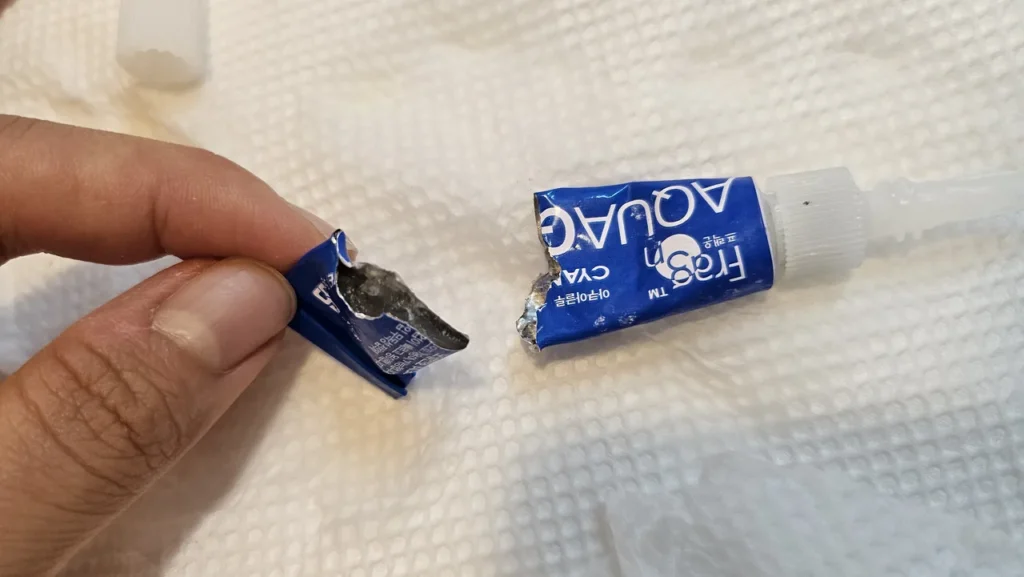
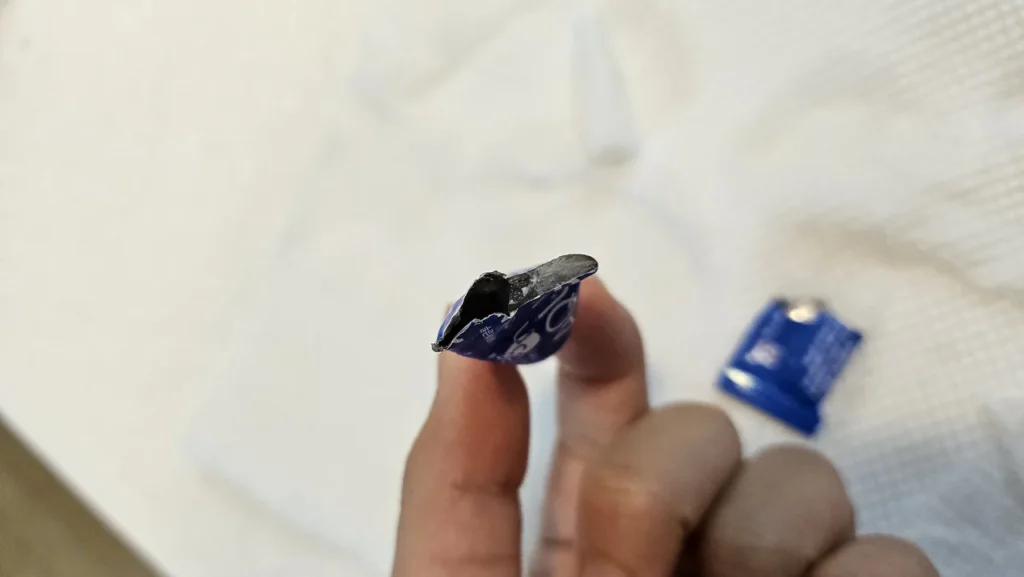
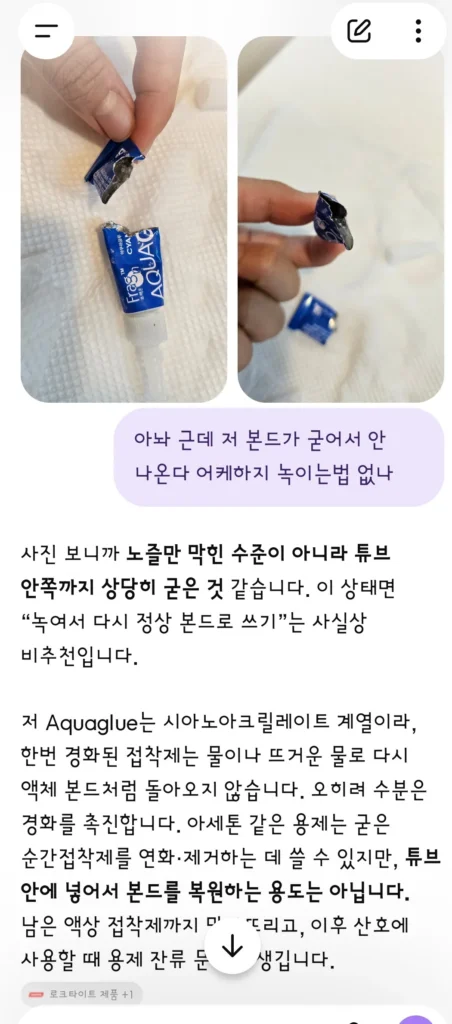
Ah… the glue had hardened and would not come out. When I squeezed it, the tube split in half.
Was there something wrong with the conditions in the tank cabinet, or is this just a product that does not last long? I needed to do something right away….
GPT has been really helpful with running the tank. It advised me to stand it up using only the frag station as a temporary fix, so I decided to leave it like that until the glue arrived.
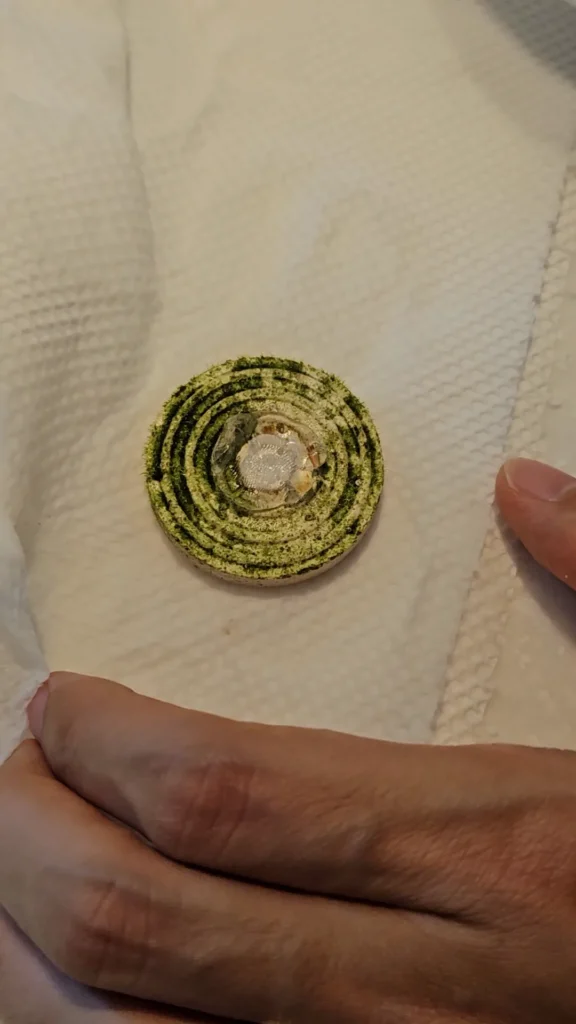
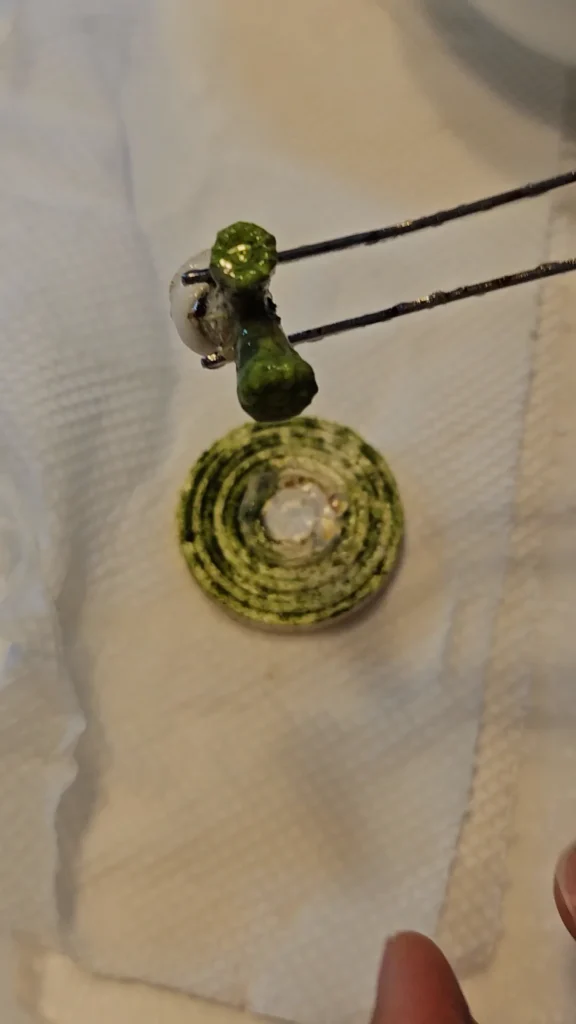
First, I spread the frag station material, softened in hot water like clay, flat over the frag base and set the coral on top.
I shaped it evenly so the frag station material could support the coral’s body well.
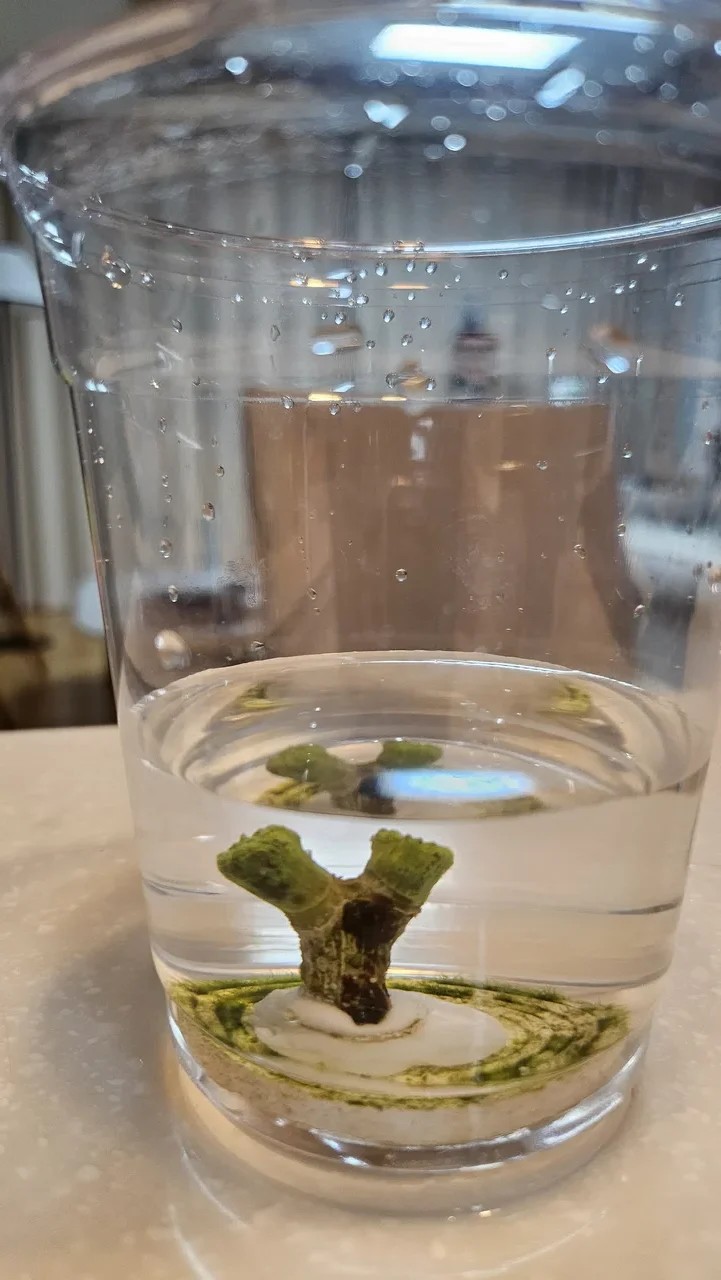
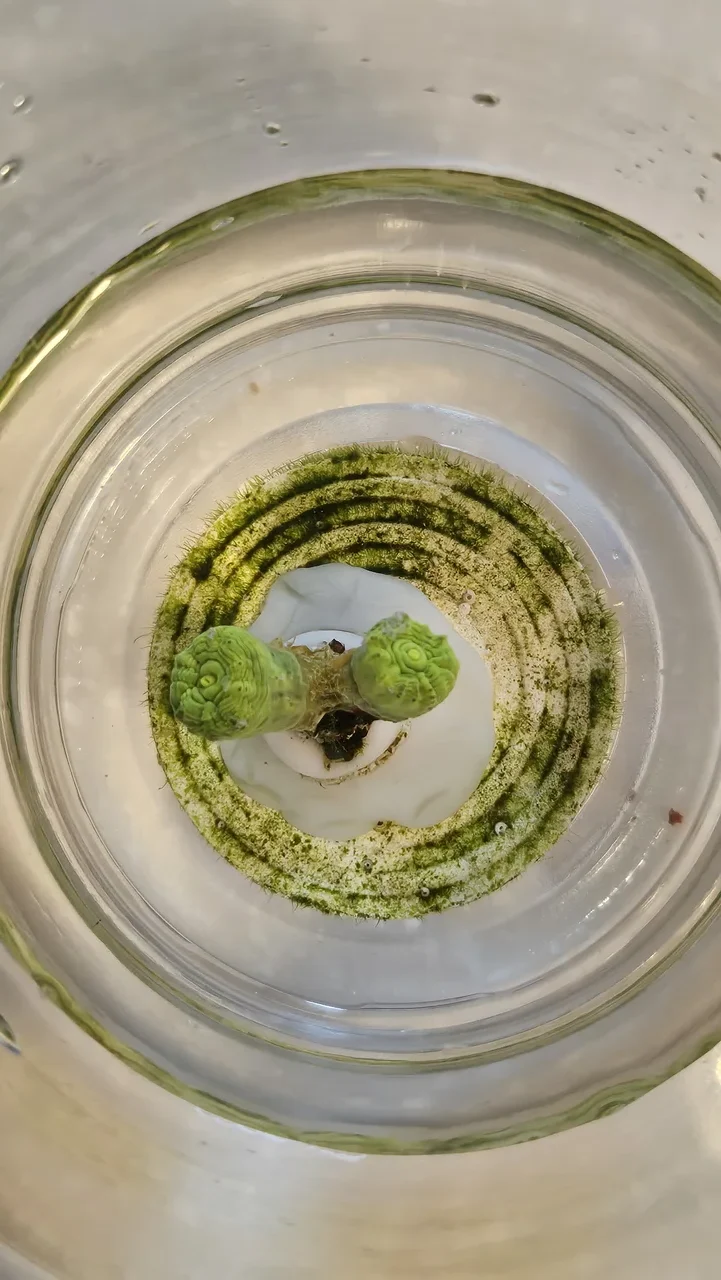
If it stands on the bottom without wobbling, it is done! To keep the coral’s stress as low as possible, I immediately put it in some tank water I had set aside and checked one more time that it was standing properly.
This little one has such an odd color and is standing just fine. Torch and leather corals with long polyps look pitiful when they droop out of water, but the candy cane somehow looks strong even out of the water. Very reassuring.
So that was the rushed emergency treatment, somehow finished. It is only a tiny 45 cm cube tank, but why do so many things keep happening in it? It gets pretty dramatic for such a tiny 45 cm cube tank, lol
Once the emergency was over, I did not want to go through the annoyance of dried-out glue again, so I looked into why it had dried out.
I keep the glue in the tank cabinet. Water sometimes splashes during water changes, and the cabinet itself can be humid, so I guess moisture got in after I used it before and made it harden.
I hope this little friend lasts a long, long time.
I have kept the torch coral since setting up the tank and the leather coral since its early days, so I have grown especially attached to them. Compared with my other, relatively still corals, their gently waving polyps are what make them so appealing.
It was hard to watch when their polyps pulled all the way in and they shrank. I kept coming up with theories and trying things, and it really wore me out. In the end, though, it seems the biggest problem was the temperature.
After buying an OKE-6428HC cooling/heater temperature controller and setting it to 25°C, the torch coral is definitely looking better.
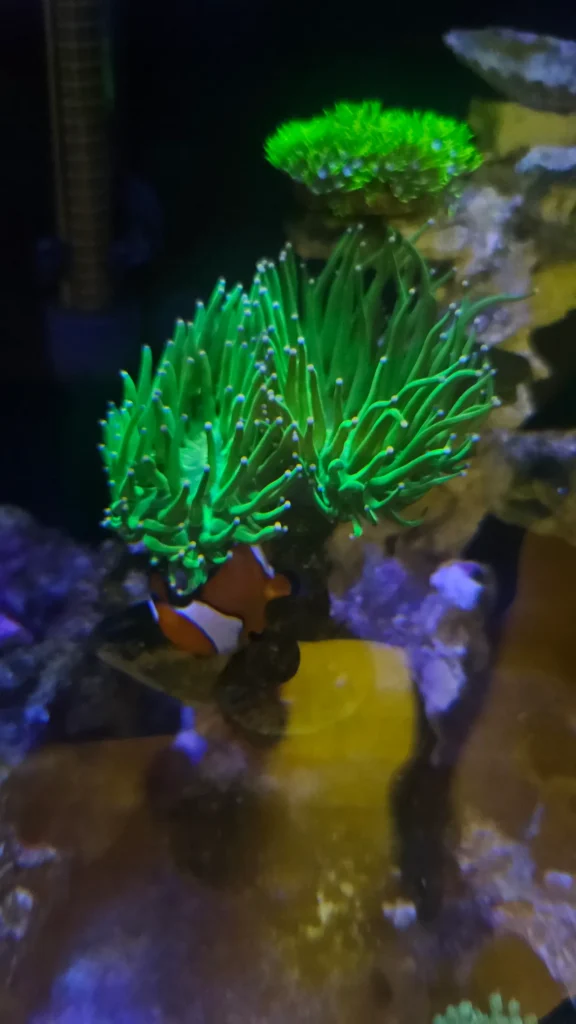
The mouth is still visible in the middle, but the outer polyps are growing well and it looks fuller. The clownfish looks happy too.
It was probably a buildup of several factors: a single head splitting into two, high temperature, insufficient nutrients, and so on. But in my tank, temperature felt like the biggest factor.
I tried all sorts of things—phosphate dosing, adding activated carbon, and more—but it turned out the glass thermometer was the issue…
If your corals have been looking worse and you have only been using a glass thermometer, it might be worth checking its calibration.
I was looking at the number on the sensor and something felt off. The glass thermometer stuck on right next to it was reading 2°C lower. Same water, both of them sitting in it.
The glass thermometer on my tank had been reading 2°C below the real water temperature. Shocked.
I had been keeping the tank at 25–26°C going by that thermometer. The sensor says 27–28°C. So I have been growing corals in water 2 degrees warmer than I thought.
It is such a simple thing that it never crossed my mind it could be wrong. A glass tube with a printed scale and red liquid moving up and down — I had never once questioned it.
A while ago I added a temperature controller, set it to 25°C, and wrote a whole post saying the temperature swings were sorted out. But that 25°C was measured with this thermometer. Going by what I know now, the water was actually at 27°C.
Summer is worse. I came home from work, saw 27°C, got worried and added a cooling fan — and that reading was really closer to 29°C. Putting the fan on and telling myself it was fine now, that part bothers me.
If I put my hand in the water I cannot tell 27 from 29. It just feels lukewarm.
It also makes me look again at why the leather coral recovered while the torch stayed half-hearted. The torch is the one that handles heat worse. PO4 dosing, carbon — I kept looking for the culprit somewhere else, and it may have been the temperature all along.
For those months the torch was sitting in water I believed was 25°C.
I am not certain, of course. I changed the dosing, the carbon, and the controller around the same time, so I still do not know what did what. The one thing that is clear now is that the temperature was never the number I thought it was.
From what I read, cheap thermometers being off by this much is common enough, glass or digital. I did not get an unusually bad one — that is just what they are. Not knowing that was on me.
What I do first
The urgent part is dropping the controller setting by 2°C. If I leave it as it is, the tank keeps running at 27–28°C. In summer that matters more.
Putting the thermometer in ice water would tell me whether the 2 degrees is a constant offset or something that only shows up at certain temperatures. Have not done it yet.
And I need to go back over the torch. If it was not recovering because the tank was too warm rather than because of PO4, the last few months read differently.
If you are going by a single glass thermometer, hold something else next to it once. It gets annoying when they do not match, but that beats not knowing.
I did not take the glass thermometer off. Thought about it, then left it. I know it reads 2 low, so I just add them.
One day, all of a sudden, my star polyps and acan coral looked fine, but…
The polyps on my torch coral gradually became smaller, the mouth in the center became visible, and the body of my leather coral grew thinner until its polyps stopped coming out altogether.
I had already lost a bubble coral and a glove polyp before, even though the other corals were fine. They had slowly declined until they died, so seeing this happen again was really upsetting.
There was no obvious tissue necrosis or serious problem like brown jelly, but these were corals that had never caused me trouble before. Their less-than-full appearance kept bothering me.
What I suspected
The clownfish
The first thing I thought about was my clownfish. Nemo has rubbed his body against the torch every time I look at the tank for more than a year.
Still, he had been doing the same thing for more than a year, while the coral had gotten worse rapidly over the past few weeks. It was hard to blame Nemo alone. The leather coral, after all, is a coral he never rubs against.
Temperature swings
Summer water temperature was another concern. When I measured the water after getting home from work, it had reached 27°C on hot days, so I added a cooling fan.
With the cooling fan running, the temperature kept dropping. When the air conditioner, a fan, and the cooling fan were all running in the evening, it could fall as low as 22°C.
In winter, the heater keeps the temperature stable by running whenever it falls below the set point. But I had no device that would turn the heater on when the temperature dropped, so the swings had recently become more severe.
High KH/Alk and very low PO4
I started by looking back at the readings I had taken with my Salifert test kits.
Then I kept thinking about the high KH, the changes after water changes, the low PO4 readings, the MicroBacter7 I had been adding every day, the organic matter that may have built up in a tank without a skimmer, and the possibility of chemical irritation or disease between the corals.
Water parameters
Thinking about it based only on intuition felt like going around in circles, so I gathered the measurements I had taken so far.
Date
KH
NO3
PO4
Apr 17
12.8–13.1
About 15
About 0.06
Apr 26
10.9–11.2
10–15
0.4 in the record
May 10
10.1
About 10
About 0.015
Jun 28
10.9
10–25
0–0.03
Jul 7
12.8
5–10
0–0.03
Jul 9
12.1
Not measured
0–0.03
Jul 11
11.5
Not measured
0
Jul 12
11.5
Not measured
0
Jul 19
10.5 (after a water change with Red Sea salt)
Not measured
0
Units: KH is dKH, and NO3 and PO4 are ppm. Ca records were about 450–480 ppm on Apr 17, about 440 ppm on Apr 26, and about 400 ppm on May 10.
Looking at the measurements, PO4 kept falling and eventually reached 0. NO3 did not change much, while KH showed the biggest variation.
I had read that the recommended normal range for KH was 8–10, but mine had stayed much higher than that range.
Until now, I had thought of NO3 and PO4 simply as numbers that create algae. I assumed lower was always better because higher levels meant more algae and a dirtier tank.
But when I looked into it, I found that both are nutrients used by corals, their symbiotic algae, and microorganisms. Too much can be a problem, but starving the tank completely is not a good state either.
In this tank, it looked less like NO3 had completely bottomed out and more like PO4 was relatively deficient.
KH is related to the water’s buffering capacity against sudden changes in acidity and to the process by which corals build their skeletons. That does not mean high KH is always bad.
In my tank, KH stayed high while PO4 was barely detectable, and there were also changes before and after water changes. I suspect this combination may have been one of several factors that put stress on the corals.
What I changed
Dosing PO4 with NeoPhos
After setting up the tank, I had been adding a few drops of MicroBacter7 every day.
When I first set up the tank, I was told to keep adding two or three drops a day, so I continued. It turned out that it can reduce nitrate and phosphate.
Could the product have been continuously breaking down PO4? I wondered about that, so I bought NeoPhos to replenish only PO4 and added ten drops at a time.
I added it for a week. Three or four days after I started, the leather coral, which had not extended a single polyp, began to extend them. After about a week, the leather had completely returned to its original condition!
The torch coral seemed a little better, but the effect was not as clear as it was with the leather.
Adding activated carbon
I also added activated carbon around the time I began supplementing PO4.
Whenever I searched, I found that leather corals can release chemicals that affect other corals, and that activated carbon can also help remove other substances that build up in a tank.
Since I run my tank without a skimmer, I have treated activated carbon almost like a good-luck charm whenever a major problem appeared. This time, I added it too.
I added PO4 and activated carbon around the same time, and as I mentioned above, the leather coral recovered well afterward.
Still, I also applied the PO4 dosing, activated carbon, and temperature controller around the same period, so I do not yet know which measure had a direct effect.
A cooling/heating temperature controller
I mentioned the temperature swings earlier. After searching, I found that a cooling/heating temperature controller could improve the situation.
When the temperature falls below the set point, it supplies power to the heater and cuts power to the cooling fan.
When the temperature rises above the set point, it cuts power to the heater and supplies power to the cooling fan.
I set it to keep the water at a steady 25°C. By the time I set up the controller, the leather had recovered to its previous condition, while the torch had not, so I will have to watch how the torch progresses.
The leather recovered, but the torch is still not there
After taking several measures, the leather completely recovered and returned to how it looked before.
The torch is a little ambiguous. Some days it looks better, and on other days its polyps look smaller than usual. It is frustrating….
I have taken a breath, and I think I need to keep the measures above consistent and watch the torch for a while longer.
This time, I really felt how important it is to keep measuring the water parameters consistently.
When my bubble coral, glove polyp, and fish died before, I was not measuring the water parameters, so I had no way to know what the problem was.
This time, fortunately, I had water data, so I was able to take the measures I needed. I am really glad about that.
Saltwater is really not easy.
Update (2026-08-03)
The 25°C here was 25 on a glass thermometer. I later found out that thermometer reads 2°C low, so the tank was really running at 27°C. The torch not opening back up may be tied to that as well.
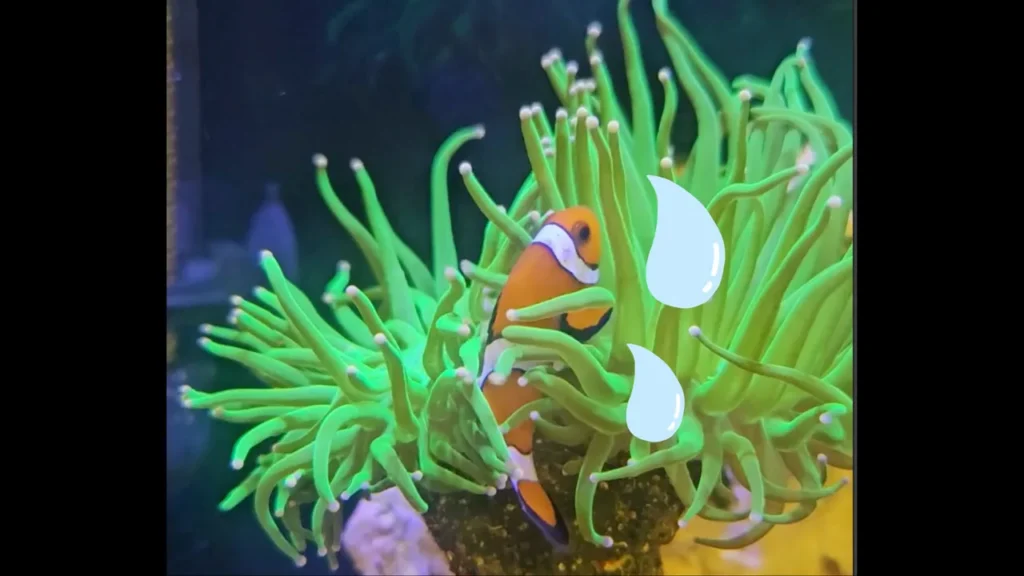
My once fluffy torch coral is starting to look bald.
Maybe the clownfish has been rubbing against it too much?
The clownfish I keep now, Jamo, really loves this torch coral.
The other captive-bred clownfish I had before did not care about corals at all.
When people talk about clownfish in reef tank communities or YouTube comments, I think most people picture them rubbing against an anemone. We did too.
But the captive-bred clownfish I had did not show any interest in corals.
So I had mostly given up on that idea. Then I saw the wild-caught clownfish rubbing against the torch coral for the first time, and I was honestly really happy.
Since the first time I noticed it, Jamo has been rubbing against the torch almost every time I look at the tank.
But about two weeks ago, the torch coral’s polyps started getting smaller like in the photo, and the mouth area became much easier to see.
I wondered if the temperature had gone up because it is summer, but it was 26 degrees Celsius, which is the same as usual.
Other corals like the acan, leather coral, and green star polyps are actually growing quickly, and they have looked even more active over the last two weeks.
I am also still doing a water change once a week.
The water parameters I checked today were:
Kh/alk: 10.9
Po4: 0
No3: 0.25
Po4 is the phosphate reading. For corals, too much phosphate can lead to algae and water quality problems, but keeping it near zero for too long does not seem ideal either.
LPS corals like torch corals still seem to need a small amount of nutrients in the water to stay fully inflated. When Po4 reads zero, the tissue can look pulled in, and the mouth in the center can stand out more. So this time I am not only looking at Jamo rubbing against the coral. I also think the low Po4 may be related to why the torch coral’s mouth is showing. Of course, I cannot blame Po4 alone. The relatively high Kh, low No3, MicroBacter7, and limited feeding probably need to be looked at together.
After looking at those numbers and talking through the tank’s current condition with GPT, one suspicious point came up.
That was the MicroBacter7 I had been adding steadily, five drops every day.
Because this tank does not have a skimmer, I have been limiting feeding as much as possible and adding MicroBacter7 consistently.
I had been thinking of it as a bacterial supplement that helps break down organics, but that process may also help keep the tank’s Po4 level low.
I am going to use Brightwell NeoPhos to raise Po4 very slowly and watch how the torch coral responds.
If Po4 gets too high, I will probably have to fight algae again. Saltwater tanks really are not easy.
Update (2026-08-03)
The 26°C here was measured with a glass thermometer. I later found out it reads 2°C low, so the water was actually 28°C. I need to go back over the part where I ruled temperature out.
When I look around the tank, I see plenty of algae, floating bits, and things I can’t quite identify. Most of the time, the trochus snails or peppermint shrimp clean them up pretty quickly.
This time, there was a green dot on one side of a clam shell, so I just thought it might be a slightly brighter bit of algae.
But when I looked more closely, one tiny strand of star polyps was moving!
I had left the star polyps on top of the clam shell for about a month, and one strand had spread across the shell.
When I first set up the tank, I started it with one very small torch coral and one star polyp coral.
Star polyps, the coral that had been there from the very beginning of the tank, even before I added any fish.
Seeing it cover the frag and stretch beyond the frag plug is honestly pretty fascinating.
Maybe the clam shell is too light, but when I check the tank after waking up or after getting home from work, the shell is often sitting on the sand bed.
I think the trochus snails probably push it around while wandering for food.
A while ago, a crab used to hide inside the live rock and come out at night to shove all the corals around. Could this be happening again?