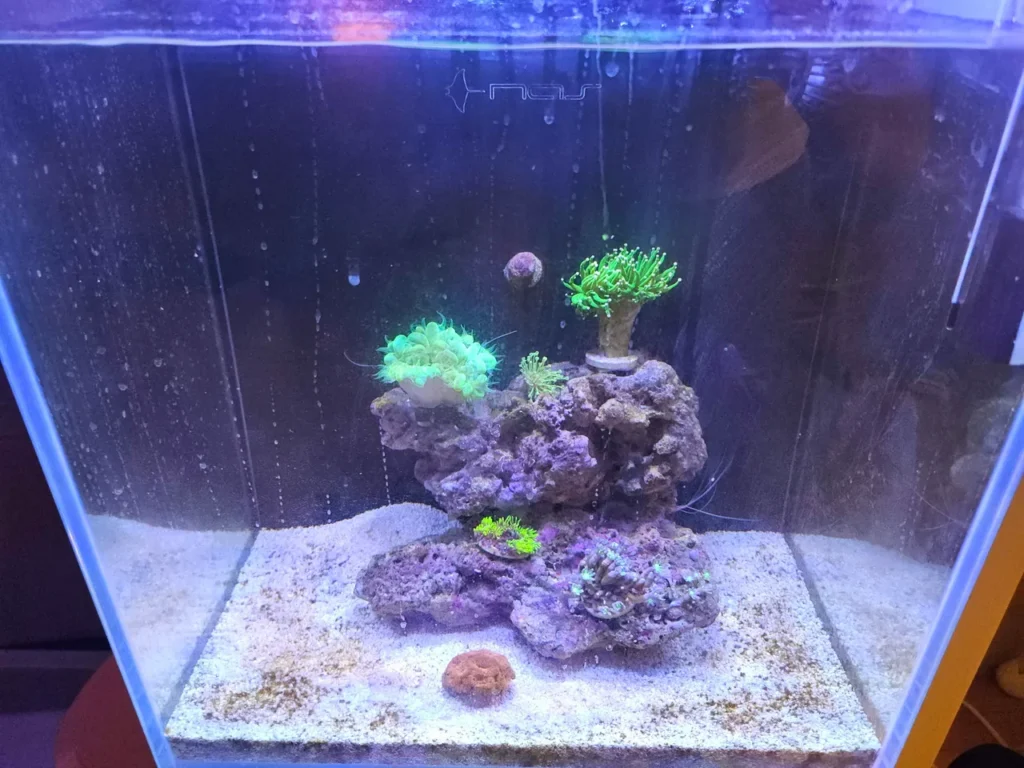
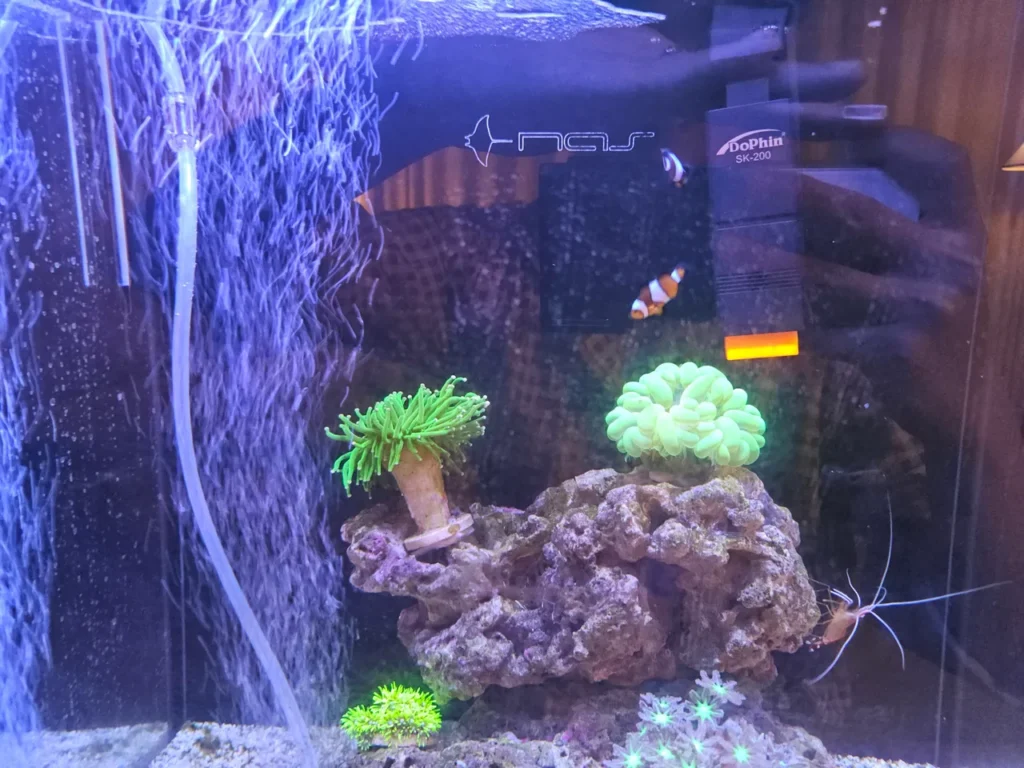
I was looking at the number on the sensor and something felt off. The glass thermometer stuck on right next to it was reading 2°C lower. Same water, both of them sitting in it.
The glass thermometer on my tank had been reading 2°C below the real water temperature. Shocked.
I had been keeping the tank at 25–26°C going by that thermometer. The sensor says 27–28°C. So I have been growing corals in water 2 degrees warmer than I thought.
It is such a simple thing that it never crossed my mind it could be wrong. A glass tube with a printed scale and red liquid moving up and down — I had never once questioned it.
A while ago I added a temperature controller, set it to 25°C, and wrote a whole post saying the temperature swings were sorted out. But that 25°C was measured with this thermometer. Going by what I know now, the water was actually at 27°C.
Summer is worse. I came home from work, saw 27°C, got worried and added a cooling fan — and that reading was really closer to 29°C. Putting the fan on and telling myself it was fine now, that part bothers me.
If I put my hand in the water I cannot tell 27 from 29. It just feels lukewarm.
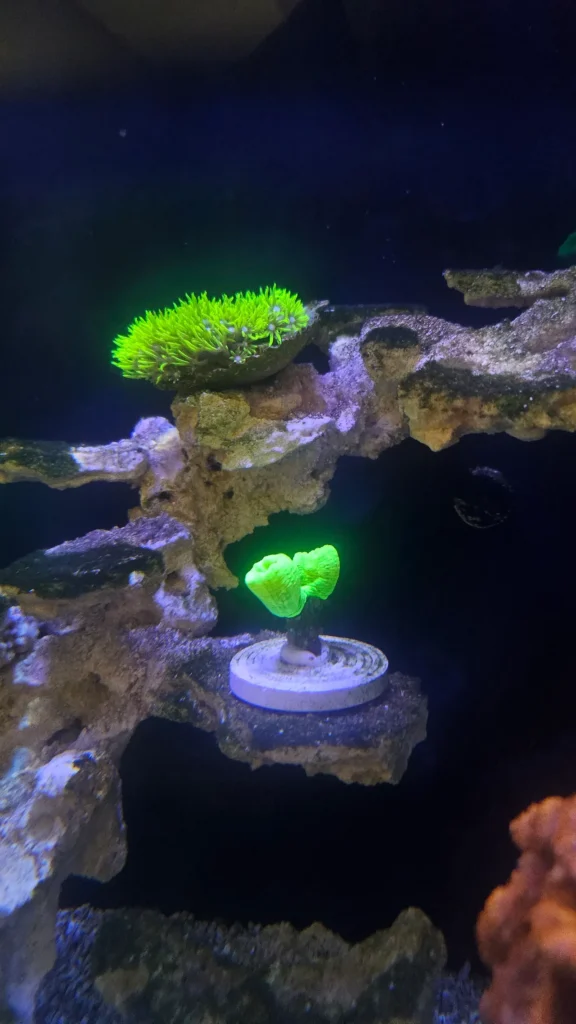
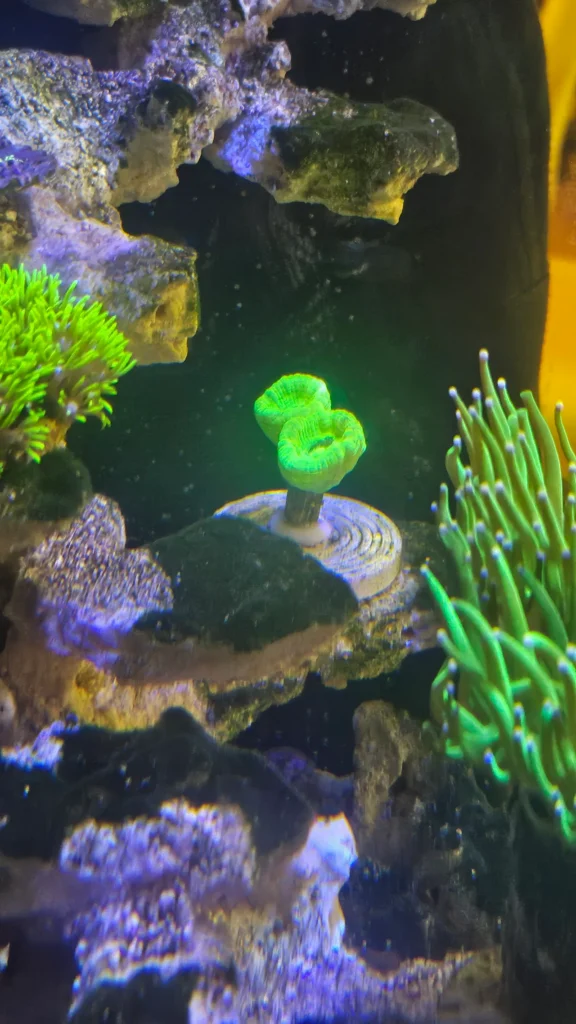
It also makes me look again at why the leather coral recovered while the torch stayed half-hearted. The torch is the one that handles heat worse. PO4 dosing, carbon — I kept looking for the culprit somewhere else, and it may have been the temperature all along.
For those months the torch was sitting in water I believed was 25°C.
I am not certain, of course. I changed the dosing, the carbon, and the controller around the same time, so I still do not know what did what. The one thing that is clear now is that the temperature was never the number I thought it was.
From what I read, cheap thermometers being off by this much is common enough, glass or digital. I did not get an unusually bad one — that is just what they are. Not knowing that was on me.
What I do first
The urgent part is dropping the controller setting by 2°C. If I leave it as it is, the tank keeps running at 27–28°C. In summer that matters more.
Putting the thermometer in ice water would tell me whether the 2 degrees is a constant offset or something that only shows up at certain temperatures. Have not done it yet.
And I need to go back over the torch. If it was not recovering because the tank was too warm rather than because of PO4, the last few months read differently.
If you are going by a single glass thermometer, hold something else next to it once. It gets annoying when they do not match, but that beats not knowing.
I did not take the glass thermometer off. Thought about it, then left it. I know it reads 2 low, so I just add them.
When you keep a tank, there are a few big events. Bringing in new equipment is one, and changing the aquascape is another, but personally, bringing home new livestock feels like the biggest one.
Usually I study quite a bit before bringing something home. I look up whether it can live with the livestock I already have, whether it fits my tank size, and whether the difficulty level is too much. Sometimes I spend more time thinking before buying than I do actually keeping it.
But this candy cane coral was a little different. I had absolutely no plan to bring one home, and on the way to the aquarium shop I did not even know there was a coral called candy coral.
What I mean is, to start with the conclusion, I brought it home because it looked like the cheapest and easiest option.
The coral I was originally looking for was something else
The reason I went to the aquarium shop that day was simple. My tank already had a lot of green and reddish corals, so I wanted to add a slightly different color.
It had been a while since I visited an aquarium shop, and after only seeing the tiny corals growing at home, I got excited seeing large corals that had grown for a long time in a good setup. Then one white, jewel-like coral caught my eye.
“Sir, how much is this one?”
“It’s about $80.”
“?!”
I knew large corals were expensive, but since this one was small, I thought the price would be lighter. I was wrong.
I gave up right away and started looking for another coral, then found one with a color I liked.
“Then this one…?”
“That one is about $2,000 ^^”
The price was scary, but what was scarier was that the first coral, at about $80, was starting to look cheap.
So I picked the candy cane coral
That was when the candy cane coral came back into view.
It was not a coral I had picked out from the beginning, and it was not a coral whose name I knew before going there.
But at about $20, the price was easy to accept, and even though its color was still on the green side like the star polyps, torch, and leather corals I already had, I liked that it looked like a little tree.
More than anything, the cute one was also cheap.
I brought it home without really knowing what a candy cane coral was
Honestly, even when I brought it home, I did not really know what kind of coral a candy cane coral was.
It was just round, the color looked fine, and most of all, the price was less scary than the other corals. So I thought, “This seems good enough?” and brought it home.
After I got home and looked it up, candy cane coral turned out to be an LPS coral. It has parts that look like round heads, and apparently when it is doing okay, the flesh puffs up nicely.
If I went deep into the theory, I could probably explain more, but what I first felt was simple.
It is cuter than I expected.
It is not a coral that sways dramatically or has a huge presence, but once the lights come on and the flesh puffs up, I keep finding myself looking at it. Maybe because the heads are so round, it is a slightly different kind of fun to watch compared with the other corals.
At first, I brought it home because it looked cheap and easy. But after watching it for about a month, I realized that “easy” did not mean I could pay less attention to it.
If anything, because it was a coral I brought home without much pressure, I ended up looking at it more often. Is it a little puffier today? Is the color still the same? Is it too close to the coral next to it? I keep checking those little things for no real reason.
After two months, it was more fun to watch than I expected
It is not a coral that waves around beautifully like a torch or leather coral, but after keeping it for a while, it has its own fun.
The branch-like parts look a little different under the lighting, and inside the overall color of the tank, it feels like it fills an empty spot.
At first, the price was what caught my eye.
But bringing home a mini coral frag again after a while made me realize that even a little growth is noticeable, and that makes it fun to watch.
Is it a little puffier than yesterday, is the color okay, is the spacing from the surrounding corals okay? When I look closely, the small differences show up, and that is pretty fun.
The water looks clear, but why are there days when corals stay a little less open than usual, or livestock behave differently?
While keeping a 45-cube reef tank, the most frustrating moments were probably when I couldn't figure out the cause of what was happening in the tank.
Dealing with hitchhikers, deciding on a water change schedule, and dealing with algae growth are all difficult, but for me, the hardest part was the time when I had to guess at the reason corals or other livestock were doing poorly.
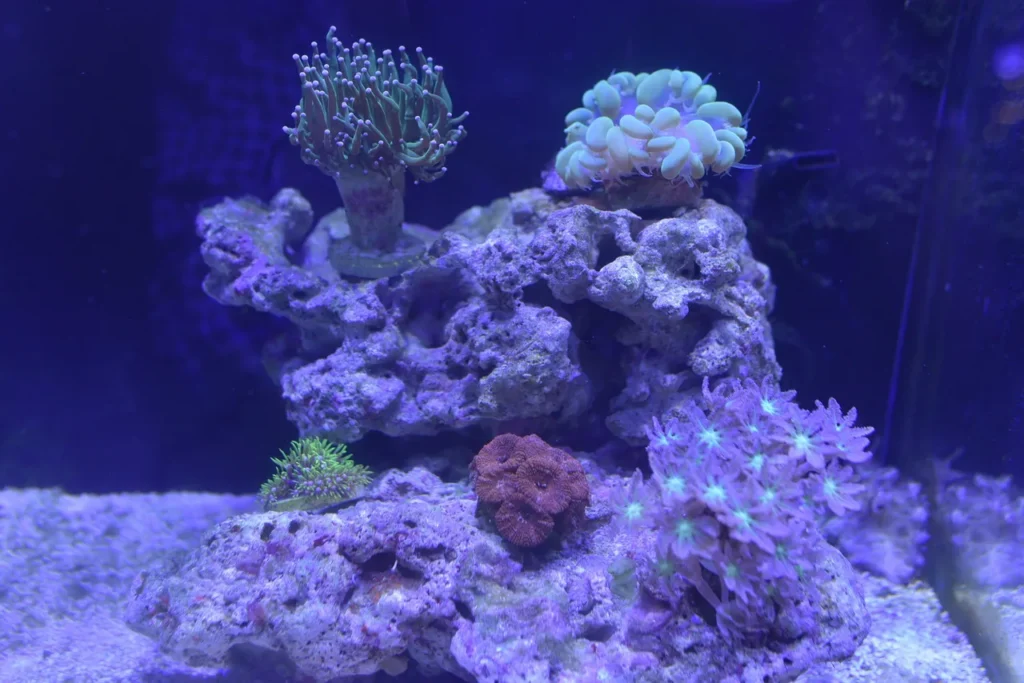
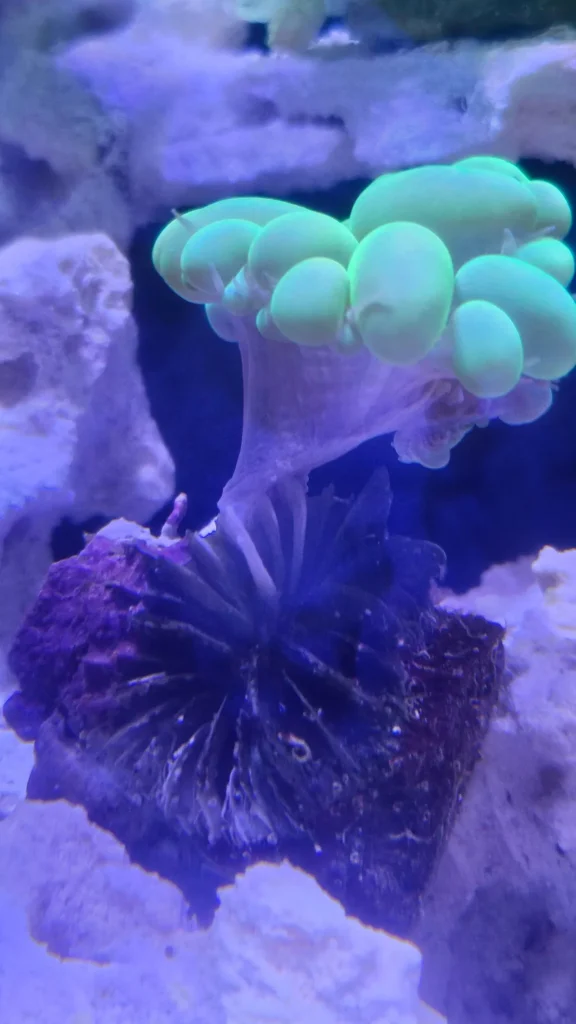
The tank back when the globe polyps and bubble coral were growing healthily.
For about a year after starting the 45-cube tank, I was watching the tank's condition with my eyes and my gut. Temperature and salinity are relatively simple. They're easy to measure, and you can immediately understand why they matter without anyone explaining it to you.
But I kept wondering whether the values people commonly call water parameters really needed to be measured at all. Each one needed its own test kit, and the testing methods looked more difficult than temperature or salinity, so I kept putting it off.
Then something happened. I did a water change at the same time and in the same way as usual, but after the water change, white spots started appearing on the fish, the tips of the globe polyps that used to open fully no longer opened, and brown algae gradually started covering the globe polyps.
I especially knew something was wrong when Nemo, who had been eating well and breathing normally, stopped eating and started breathing harder and harder.
I searched online. Since I kept seeing people say to do a water change if something seemed wrong, I started doing a water change once a day, and thinking the corals might be lacking oxygen, I hurriedly bought an airstone and added bubbles too.
With the airstone running and daily water changes, things seemed to improve a little. Then, when I looked at the tank after work with a nervous feeling, I saw a dead fish. Not long after that, the globe polyps died too.
After that, the bubble coral, the yellow tang, and the coral I called the bouquet coral suddenly started doing poorly too, and then were gone.
It was really painful. And I kept wondering what on earth was wrong. I had done the water change the way I usually did, so was the problem with the water change? Or was it something else?
I remembered water testing, which I had felt wasn't really necessary. If I had tested the water, would I have been able to figure out what the problem was?
I decided to start measuring the water. I wanted to figure out what absolutely needed to be checked in a tank where I keep corals and fish together, so from that point I looked a little more into individual parameters and decided to measure four high-priority ones.
The four I decided to measure
KH/Alk and Ca are closer to the side that helps corals build skeletons and stay stable. NO3 and PO4 are closer to the nutrient side connected to food, waste, filtration, and algae.
Simply put, one is the flow corals use, and the other is the flow that stays in the tank and builds up there.
KH/Alk: alkalinity connected to pH buffering and coral skeleton formation
Ca: calcium that LPS and stony corals use to build calcium carbonate skeletons
NO3: nitrate left behind after food, waste, and biological filtration
PO4: phosphate connected to food, organic matter, and even the storage capacity of rock and sand
I wrote up separate notes about actually running each test.
Salifert KH/Alk test instructions
Salifert Ca calcium test instructions
Salifert NO3 nitrate test instructions
Salifert PO4 phosphate test instructions
KH/Alk: the buffering strength corals rely on
The reason I looked at KH/Alk first was that I felt it was directly tied to coral response. KH is not pH itself, but alkalinity, which shows how well the water can resist shifts toward the acidic side.
LPS like torch coral and Acan coral show water changes very clearly. When the polyps open less or the tissue looks shrunken, I can't say for sure that there's only one cause, but it is worth checking whether KH is swinging.
When I first measured it, the value came out around 12.8 to 13.1 dKH, which was clearly higher than the commonly known 8 to 12 dKH range.
Based on that value, I formed a hypothesis that the KH of the new water made for a 25% water change once a week was staying higher than what the corals were consuming, and that this repeated pattern was pushing the value up.
After reducing the water change amount and testing for a month, the KH value actually moved into the normal range.
Ca: the material corals use to build skeletons
Ca is the main material in a coral skeleton. Even though LPS look fleshy and full, they still have a hard skeleton inside, and when they form new heads or thicken their skeleton, they use Ca and KH together.
The most disappointing one was the bubble coral. The once-full bubble coral slowly separated between the skeleton and the polyp tissue over a very long period of time, until it finally separated completely. I think I might have made a better judgment if I had tracked that value.
NO3: the residue left after processing food
NO3 is nitrate left after food, waste, and dead organic matter go through bacterial processes.
High NO3 doesn't immediately mean disaster, but if it stays high for a long time, it can be linked to increased algae growth or changes in coral color. On the other hand, it doesn't have to be zero either. Corals, symbiotic algae, and bacterial ecosystems also need some nitrogen source.
PO4: a value that can affect both algae and coral growth
PO4 is phosphate. People often associate it with algae, but phosphorus is also a nutrient needed for life.
The problem is that the tank can become unstable whether it is too low or too high. If it's too low, the balance between corals and microbes can be disrupted, and if it's too high, it can be linked to glass algae, rock algae, and cyanobacteria.
Moving from gut feeling to records
Of course, not all symptoms that appeared in the livestock could have been found or prevented through testing.
Still, it felt too frustrating to keep relying on gut feeling alone, and once I started measuring, at least I no longer looked at everything purely by instinct like before.
I now had a reference point for seeing how the measured values were moving behind the visible changes, like whether the water looked clear, whether the corals were open, or whether algae was increasing.
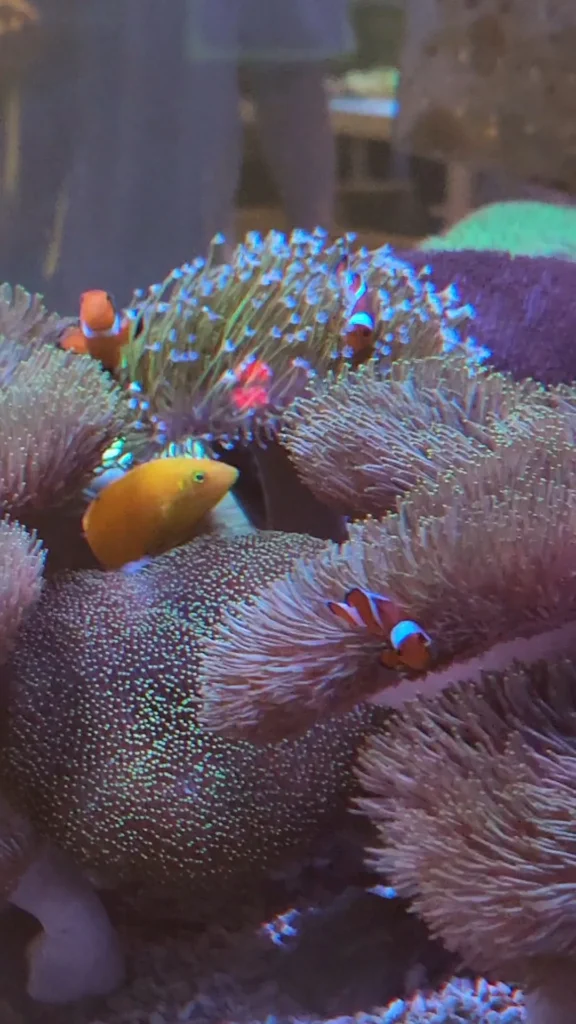
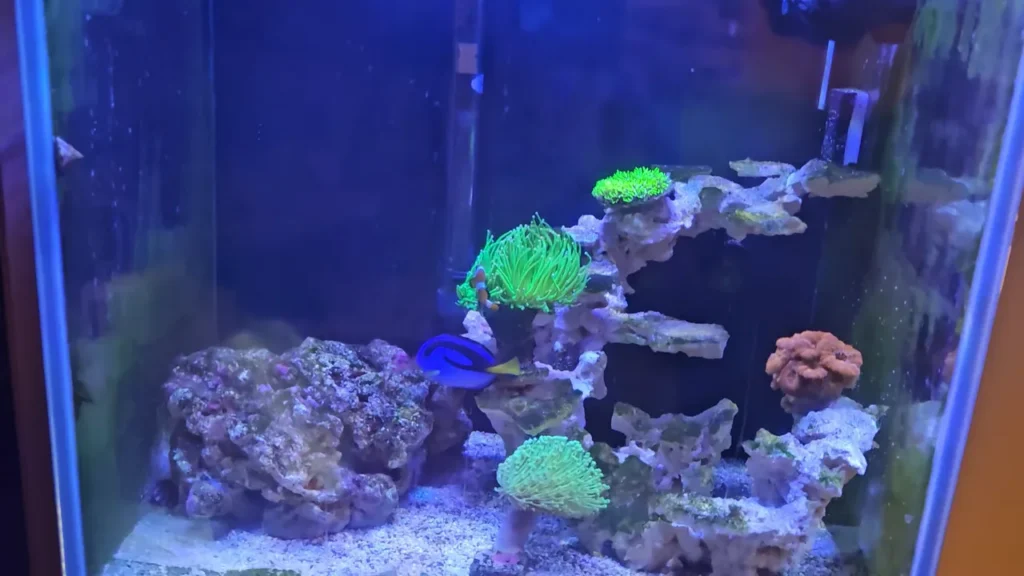
The Nemo I keep now really likes the torch coral. Its name is Jamo, short for “wild Nemo” in Korean.
Jamo is almost always rubbing against the torch like this. Watching the torch coral tentacles sway while Jamo keeps nestling into them has become one of the small joys of keeping the tank.
A guest was over, and while we were talking about the tank, I mentioned that when the flow pump turns off, the torch coral tentacles freeze in place as if they had been struck by lightning. They were curious, so I turned the flow pump off for a moment.
As soon as the water flow stopped, the torch coral tentacles barely moved, and Nemo stopped too. The way it looked confused, almost like a little fish that had suddenly lost its home, was both cute and funny.